


Zagros Mountains. Night.
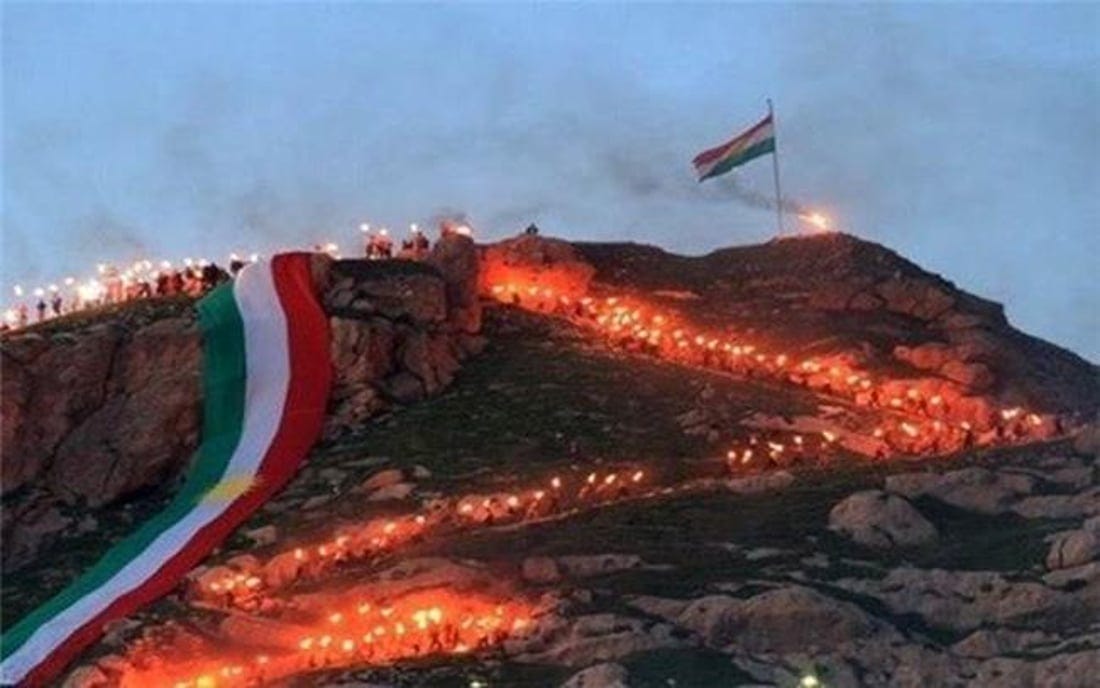
A fire on a ridge.
No microphones. No permits. No embassy behind it.
A flag lifts in the wind — red, white, green, and the golden sun at its center.
No building flies it.
No treaty authorizes it.
And yet everyone present knows exactly what it means.
The state does not recognize the flag.
The people do.
That difference is the entire story.
I. The Promise Erased
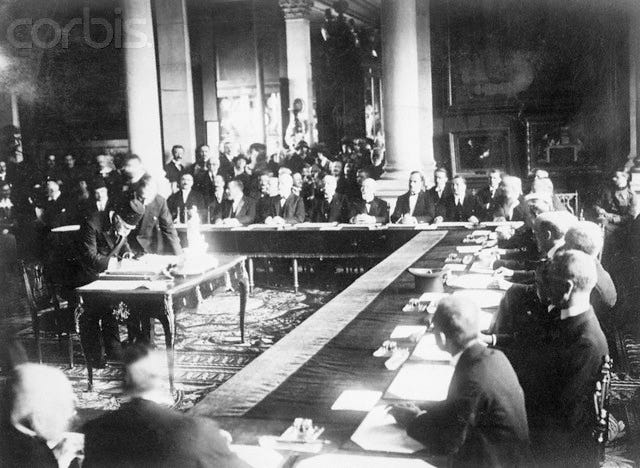
A pencil crosses a table in Lausanne.
A diplomat lifts his hand.
The year is 1923.
Thirty million people disappear into four countries.
No one in the room speaks Kurdish. No one in the room has walked the Zagros passes in winter. No one in the room will live inside the border they are drawing.
Three years earlier, the Treaty of Sèvres had sketched a possible Kurdistan — a rough shape on the page, a concession to the arithmetic of empire collapsing. Then the arithmetic changed. Turkey renegotiated from strength. The map was redrawn. The sketch was erased.
The ink dried. The borders hardened.
The Kurds remained.
Borders are negotiations between people who will never live inside them.
The Kurds were not at the table.
The Ottoman Empire did not require its subjects to be one thing.
Tribe. Religion. Region. Loyalty. These categories overlapped, contradicted, coexisted. The system held not because it was coherent, but because it never demanded coherence. Ambiguity was the architecture.
Then the empire collapsed. The new order had different requirements. Borders had to align with nations. Citizens had to resolve to a single state. Identity had to fit a census category.
The Kurds fit none of them.
The twentieth century built a world of states that required identity to match territory. Some peoples had never needed to perform that alignment.
Not because they were ungovernable, but because the new system required a clarity they had never needed to perform.
II. Identity Without Capture
Four states. Four strategies. Four different mechanisms for solving the same problem.
In Turkey: the language banned. Kurdish place names scraped from maps and overwritten with Turkish ones. Mountains renamed. The geography of memory systematically replaced by official cartography.
In Iraq: Arabization campaigns, demographic transfer, chemical weapons. The Anfal campaign — the name taken from the Quran, the word for “spoils of war” — kills between 50,000 and 182,000 people between 1986 and 1989. Over 2,000 villages destroyed during Anfal alone; since 1975, more than 4,000 Kurdish villages across Iraq had been razed.
In Iran: political parties outlawed, cultural expression classified as separatism. In Syria: an agricultural census in 1962 strips 120,000 Kurds of citizenship in a single administrative procedure. Stateless. Legally. By decree.
Administrative erasure is the state’s most polite form of violence.
And it produces the opposite of its intended effect. Every ban sharpens the language. Every renamed village becomes a name a child learns in secret. Every erasure becomes proof the state was afraid of it.
You do not suppress what you are not afraid of.
When you optimize against an identity, you do not weaken it. You clarify it. You strip away the ambivalence. You force the moderates to choose. You make the identity worth dying for by treating it as a crime.
The spring compresses.
The spring does not break.
III. Custodial Legitimacy
And yet they did not wait for recognition.
This is the part that states cannot model.
Newroz fires burning every spring — the Kurdish New Year, banned in Turkey until the mid-1990s, celebrated anyway. Not as protest, exactly. As practice. The annual re-performance of being a people, with or without permission.
Songs encoding geography. When place names are officially erased, they survive in music. The mountains named in ballads cannot be renamed by decree. They exist in the old language and the old sound, passed from voice to voice across generations in a transmission that leaves no paper trail and requires no archive. Language is not culture — it is territory carried in the mouth. Memory does not require administration. Administration cannot function without memory.
Martyrs anchoring memory. The dead become infrastructure. Names that would otherwise disappear become permanent precisely because they were killed.
This is Custodial Legitimacy — a people holding identity in collective custody, without a building, without a border anyone with power will enforce. The institution is the people.
The Kurds did not need the world to recognize the custody.
They only needed each other.
IV. Kinetic Sovereignty
When the Iraqi state fractures in 1991, the Kurdistan Regional Government emerges from the wreckage like something that had been waiting in the walls.
Ministries. Schools. Border posts. Courts. A parliament.
Not chaos filling a vacuum — a structure moving faster than recognition.
By 2003, the KRG is operating with the coherence of a state that has been practicing governance for years, because it has. The institutional knowledge did not need to be invented. It needed to be acknowledged.
In northern Syria, beginning in 2012, the cantons of Rojava establish local councils under active war conditions. Women’s councils with genuine authority. A governance structure assembled from materials at hand.
This is kinetic sovereignty. It does not arrive through diplomatic recognition. It fills the vacuum before the vacuum fills with something worse.
But kinetic sovereignty does not produce moral purity.
Between 1994 and 1998, the two dominant Kurdish factions in Iraq — the KDP under Barzani and the PUK under Talabani — fight a civil war against each other. Thousands killed. Territory divided. At one point, Barzani invites Saddam Hussein’s forces into Kurdish territory to gain advantage over a Kurdish rival.
Custodial legitimacy does not eliminate power competition. It does not dissolve the ambitions of men who want to lead the people holding themselves in trust. Statelessness is not innocence. It is a structural condition, and structural conditions produce the same human dynamics as any other.
The Kurds did not invent kinetic sovereignty.
They refined it under pressure — including pressure they applied to each other.
V. The Patron Problem
Stateless nations eventually learn the same lesson: alliances with great powers are temporary. The nation’s need is permanent. The patron’s interest is not.
In 1975, the Shah of Iran and Saddam Hussein signed the Algiers Agreement — a border dispute resolved between two states. The side payment was the Kurds. Iran withdrew support for the Kurdish rebellion fighting Saddam’s government. The CIA, following Kissinger’s calculation: a Kurdish victory was never the point, only pressure on Baghdad — withdrew alongside it. The rebellion collapsed in days. Mustafa Barzani, the movement’s founding figure, died in exile in Washington four years later. The Kurds were not parties to the agreement that ended them. They were the currency.
In 1991, after the Gulf War, the United States encouraged Kurds to rise against Saddam Hussein. They rose. Iraqi forces, permitted to fly helicopters under the ceasefire terms, crushed the uprising. An estimated 1.5 million Kurds fled toward the Turkish and Iranian borders in one of the largest refugee movements in the Middle East since 1948. The no-fly zone came later — weeks later, after the cameras arrived and the political cost of inaction rose high enough. Protection as afterthought. Abandonment as policy.
In 2019, a phone call between Washington and Ankara preceded a U.S. withdrawal from positions in northern Syria. Turkish forces moved against Kurdish groups that had spent five years, and more than eleven thousand dead, dismantling the Islamic State. The same forces that had been armed, advised, and celebrated as reliable partners were left to negotiate their own survival. The mechanism had not changed in forty-four years. Only the geography.
This is not cruelty. It is structure. Great powers have interests. Stateless nations have identity. These are not the same currency, and they do not trade at stable rates. States change partners. Stateless nations cannot change identity. When the interests shift, the alliances shift. The identity has nowhere to shift to.
When alliances fail, the Kurds return to the only infrastructure that has never withdrawn its protection.
VI. The Mountain as Infrastructure
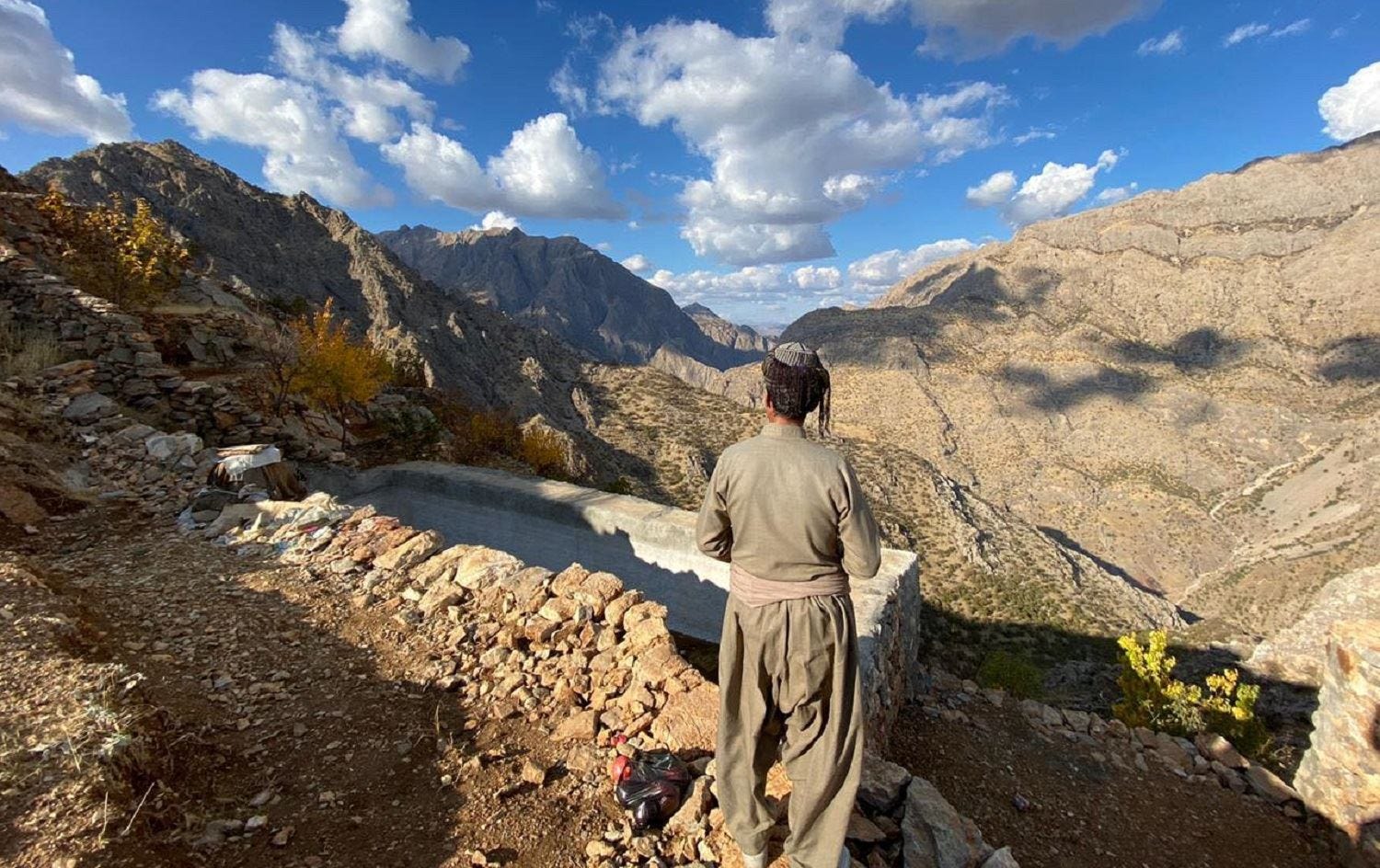
“The Kurds have no friends but the mountains.”
The mountains are not a consolation prize. They are infrastructure.
Strategic depth — it rewrites the military calculus for anyone attempting suppression. The Ottoman Empire knew this. The Iraqi army knew this. The Turkish military has been relearning it for decades.
Archive — the highlands preserve what the lowland states tried to erase. Language, practice, memory. The mountains created the conditions for illegibility.
Training ground — every generation of peshmerga forged in terrain that teaches patience, cold, the mathematics of when not to fight.
Cultural vault — the oral traditions that could not be collected in a library because they were alive in bodies moving through elevation.
Illegibility is not disorder. It is survival architecture. States govern through legibility — census, maps, taxation, the counting of bodies in fixed locations. Mountains interrupt that legibility. What cannot be counted cannot be fully controlled.
Empires collapse quickly. Identity moves at geological speed.
I have been watching this mechanism from a different altitude for thirty years. In the highlands of Guatemala’s western shore, I have watched Tz’utujil and K’iche’ communities use geography the same way — the lake, the volcanic slopes, the illegibility of local markets to the national tax apparatus. The Spanish names grafted onto Mayan place names that every local ignores.
This is not analogy. It is the same mechanism at different scale.
VII. The Fear Loop
When identity outlives the administrative system designed to contain it, conflict becomes structural.
Here is what every state eventually does:
It tries to solve the problem.
Turkey: Suppression, military campaigns, constitutional prohibitions. Then partial reversal. Kurdish language broadcasting legalized. Kurdish political parties permitted — and then banned again — cycling through legalization and suppression in a rhythm that demonstrates the mechanism perfectly.
Every crackdown hardens the identity. Every hardening produces more resistance. Every resistance justifies another crackdown.
The Fear Loop.
States fear fragmentation. Kurds fear erasure. Repression produces insurgency. Insurgency justifies repression. The system cannot fully absorb them. They cannot fully institutionalize.
This is not stalemate. It is a governance feedback loop with no exit condition, because neither party can afford to stop.
No villain required. The loop runs because each side interprets the other’s fear as proof of its own danger.
The loop runs.
VIII. What a State Would Change
Does legitimacy require enclosure?
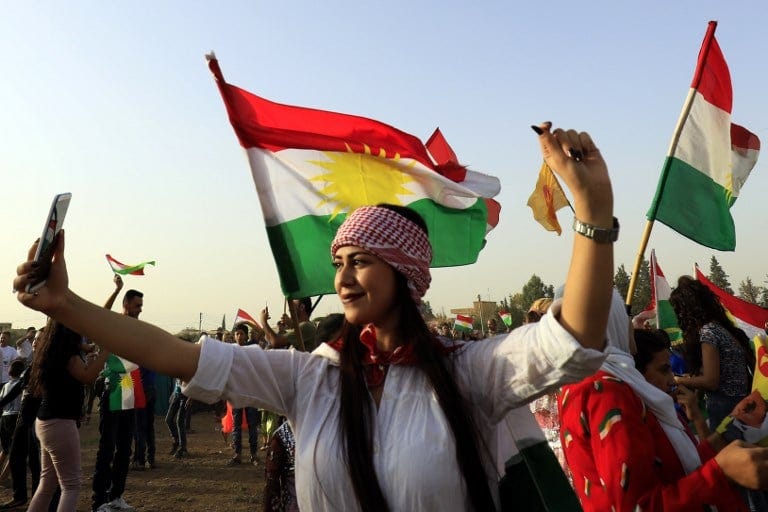
Does a people need a building for its flag?
If Kurdistan becomes a recognized state — if the signatures are gathered, the seat at the United Nations claimed — what changes?
Recognition protects. Recognition constrains. Enclosure trades freedom for durability. States inherit borders. Nations inherit memory.
There is no air defense without a state. No currency stability. No guaranteed legal protection against the regional powers — Turkey, Iran, Iraq, Syria — that have spent a century managing the Kurdish presence within their borders. The flag without a building is free. It is also exposed. Custodial legitimacy is real, and it is insufficient against a military that has decided to stop tolerating it.
The flag with a building is mortgaged. It also has a credible threat of responding.
The Kurdish national movement is not one thing. The KDP and PUK have fought each other. The PKK in Turkey operates on different political logic than the PYD in Syria. The diaspora in Germany has different priorities than the fighters in the Qandil Mountains. Recognition would require a unity that does not exist.
The building would gain a flag.
The flag would gain an air force.
The air force would require alliances.
The alliances would require concessions.
And somewhere in that sequence, the Newroz fire on the ridge becomes a permitted cultural event, organized by a tourism ministry, photographed by foreign journalists, stripped of the specific meaning it carries precisely because it was never permitted.
The Kurdish case is not unique. It is one of the clearest examples of a pattern visible wherever identity survives the state that tried to dissolve it.
IX. The Final Image
Across a century and four states, the mechanism repeats.
A child in Diyarbakır learns the banned name of her street from her grandmother, not from the map.
A teacher in Erbil grades papers in two languages.
A fighter in Qamishli sleeps with his rifle in a trench he dug himself.
A grandmother in Mahabad sings a song that encodes the name of a mountain the map insists is called something else.
Different states. Different pressures. Same memory.
It does not look like resistance.
It looks like maintenance. The daily, unspectacular maintenance of what would otherwise be lost — conducted in kitchens and mountain passes and classrooms the official curriculum does not reach.
States measure sovereignty in institutions. Nations measure it in continuity.
The world recognizes buildings.
History recognizes survival.
What happens when identity survives the system built to erase it? The Kurdish case isn’t just geopolitics. It’s a structural conflict between memory and administration—between nations that endure and states that require borders.
I too have followed Kurdish history over the years, and once again the West is attempting to use them as a wedge, this time in Iran.
Two duelling concepts of 'nation' that you bring up: a people of common language, culture and place, and the Westphalian political-economic structure of nation-states the West has made global.
The identity that rides with that of a nation-state is what most folks know, the story told by the state, one changeable, manipulated, homeless in ways that are I think beginning to be recognized.
Those of the first kind like the Kurds, as you point out, have a durability geological in time and place, and are actually vast in number, First Nations they're called here in Canada. It's interesting to me the determined effort of the nation-states to make the nations of the first kind disappear, by any means possible...a fear that goes beyond political power.
Note: The Canadian government calls the nations First Nations, a duplicitous acknowledgement, much like the 'Truth and Reconciliation' show. Both simply ongoing attempts to subsume the nations, and present the nation-state as the current embodiment of all.