

WHEN LEGITIMACY CLOSED THE LOOP
How North Korea optimized ritual and compressed reality

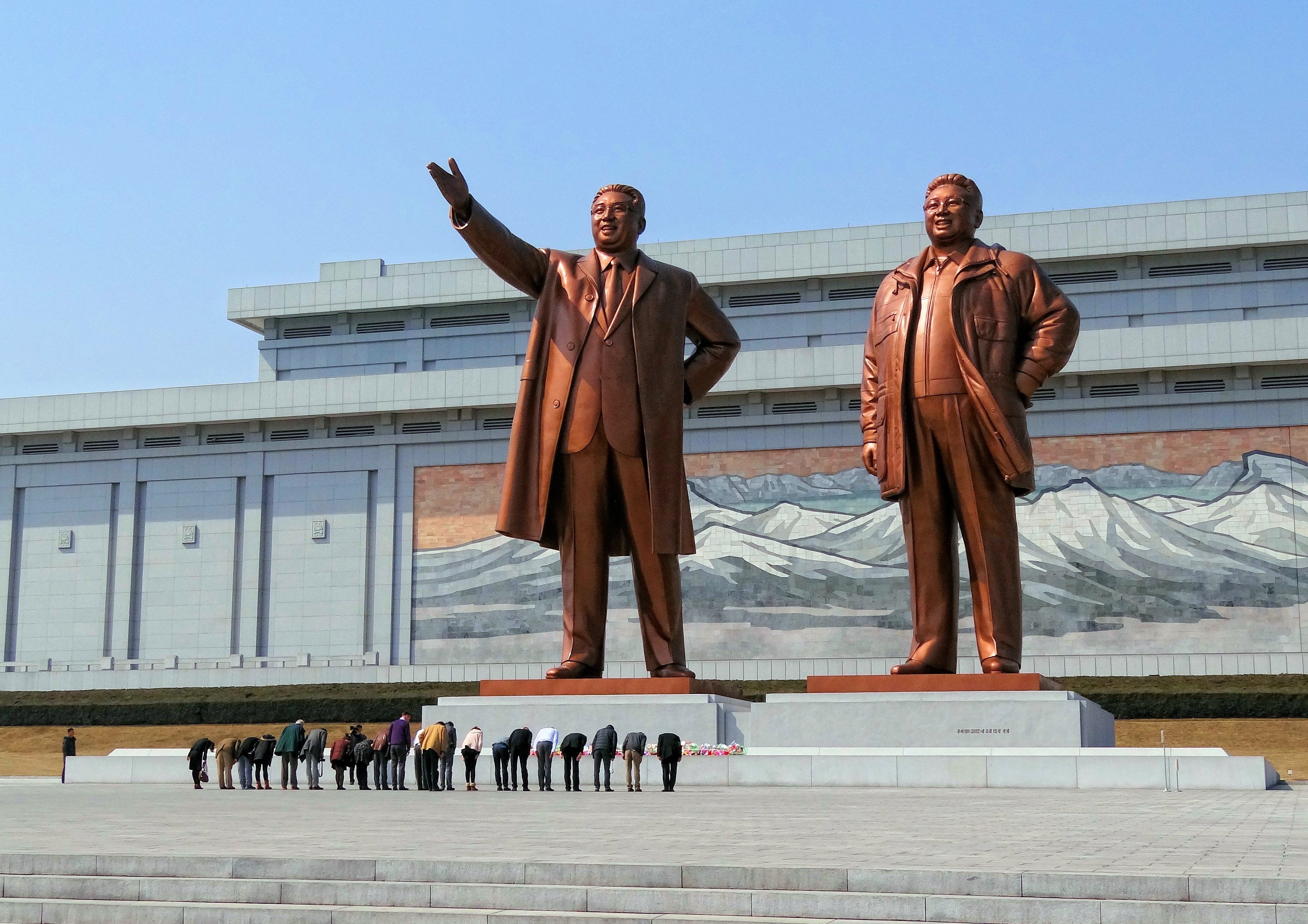
The square fills before dawn.
Not from enthusiasm. Not from fear, exactly. From the system’s requirement that it be filled. Rows of bodies emerge from the dark in gray predawn light — spacing measured, arms at precise angles, breath visible in cold air. No one speaks. No one breaks formation to look at another face. The only light comes from the stage, and the stage faces inward.
No competing signal of any kind.
One direction.
This is not what a broken state looks like.
This is what a perfected one does.
Most systems compete with themselves.
Religion fights the market for moral authority. The military fights the press for narrative control. Family loyalty fights ideological loyalty for the individual’s primary allegiance. These tensions are not bugs. They are the architecture of distributed legitimacy — the thing that makes reform possible, exit possible, survival possible when one node collapses.
North Korea eliminated the competition.
But ideology did not create the conditions for closure. Terrain did.
Look at the map before anything else.
Roughly 80% of the northern peninsula is mountainous. The Hamgyong range in the northeast, the Nangnim in the center, ridgelines running in parallel formations that separate valley from valley like walls between rooms. Arable land is scarce and flat and easy to watch. Transport corridors follow river drainage. Populations cluster in basins. Movement bottlenecks at passes.
This is not metaphor. It is physical constraint.
Mountains produce specific logics wherever they occur. Surveillance concentrates because movement concentrates. The state that controls the passes controls everything that flows through them — goods, people, information, loyalty. Mountain geography often rewards centralized authority.
The regime did not invent enclosure. It inherited it.
And then it consecrated the inheritance.
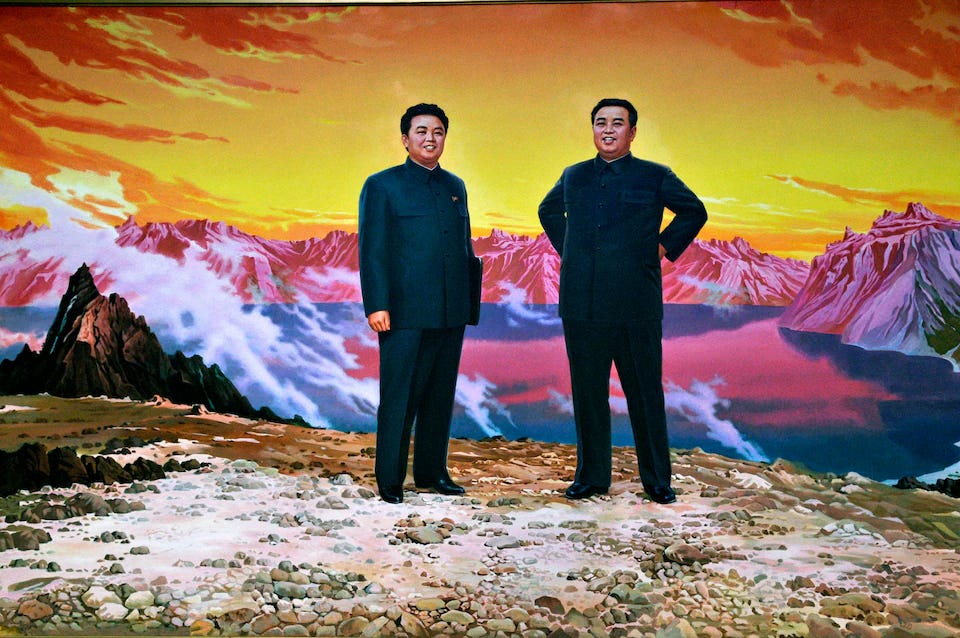
Mount Paektu rises at the Chinese border — the highest peak on the peninsula, a volcanic crater lake at the summit, sacred in Korean culture long before any political system claimed it. The Kim dynasty absorbed the mountain into its founding mythology with surgical precision. Kim Il-sung led his anti-Japanese guerrilla campaign from Paektu’s slopes. Kim Jong-il was born there — officially — during the resistance struggle, though Soviet records suggest a maternity ward in Khabarovsk.
The birthplace detail is negotiable. The architecture is not.
If time runs through the Leader — through the Juche calendar that counts years from Kim Il-sung’s birth, not the common era — and sacred space runs through the mountain, then legitimacy occupies both axes simultaneously. Temporal and geographic. The loop does not just close ideologically.
It closes cosmologically.
A system built in mountains learns quickly that external anchors are liabilities. Paektu makes that lesson sacred.
Kim Il-sung did not conquer legitimacy. He consolidated custody of it. One figure absorbed the functions that other systems distribute across competing institutions: ideological anchor, war myth, family dynasty, national calendar, spiritual cosmology. The Juche idea did not replace religion. It made the Leader its object. The state did not suppress the family. It replicated family structure with the Leader as eternal patriarch.
No external anchor remained. No parallel custody center persisted.
The custody was total.
Consider what happens to ornament when markets disappear.
In systems with price signals, value expresses itself economically. Status shows through consumption, position, measurable outcome. Remove the market and something strange occurs: value migrates to the body. To the uniform. To what can be worn and seen and counted at a public assembly.
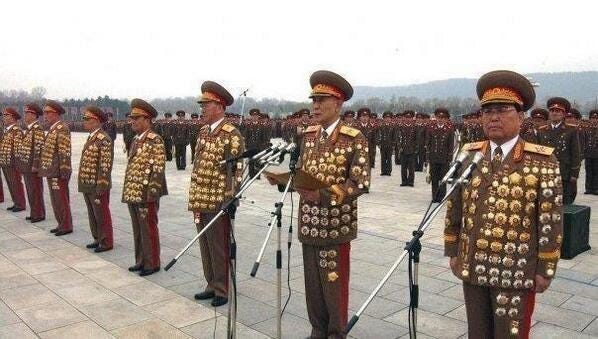
Open any photograph of the North Korean military leadership. Senior generals stand in extraordinary configurations of medals — not dozens, but collections that cover the chest from shoulder to hip, layered in rows, each one a bureaucratic artifact of loyalty performed and recognized. Western observers photograph these men with barely concealed amusement. The medals seem absurd. Excessive. Self-parodying.
That’s the wrong frame.
The medals are not memory. They are not pride. They are insulation.
In a system where performance cannot be measured against market outcomes, loyalty must be made visible. Rank becomes a wearable archive. Each decoration is a record of alignment confirmed, favor extended, relationship encoded. Strip them away and you don’t just demote a man. You erase his claim to have ever existed correctly within the system. His rank was the proof. The medals were the ledger.
This is why de-ornamentation functions as execution’s quieter cousin.
When a general disappears from photographs — when the uniform reappears suddenly sparse, when the chest that was covered shows only fabric — the message transmits without words. The hierarchy updates its understanding. Every remaining chest of medals becomes slightly more precious. Slightly more fragile.
The uniform is a scoreboard. Everyone can read it.
The parade is not a celebration.
This requires repetition because the word celebration points in the wrong direction. Celebrations mark past events. What happens in Kim Il-sung Square marks nothing. It maintains something.
Assemble. Perform unity. Confirm belonging. Disperse. Return. Assemble again.
Ritual in this system replaces persuasion because persuasion is expensive and uncertain. You cannot persuade a thousand people simultaneously in ways that guarantee alignment. You can assemble them and have them move as one body. The movement itself produces the belief it performs. Synchronized participation is not evidence of unity. It generates it.
Military parades, mass games, the Arirang Festival performances with their ten thousand moving bodies forming the Leader’s face in a human mosaic — these are not propaganda aimed at foreign observers. They are infrastructure aimed inward. The participants are the audience. The message is: you are not alone in this. Everyone here confirms it.
Every rehearsal is another loop. Every performance tightens the coil.
Stand at a Pyongyang intersection and watch the traffic police work.
Young women — selected for youth and appearance, uniformed identically — stationed at intersections throughout the capital. White gloves. Pressed dark uniforms. The arms extend at precise angles: outward, then rotating, then down, then rotating again. Each transition timed. Each motion tracing the same arc as every other motion at every other intersection in the city. Nothing improvised. Nothing personal.
The traffic is sparse. In a city of three million with almost no private vehicles, the intersections do not require this level of management. A whistle would suffice. A signal light would eliminate the need for the officer entirely.
That is not the point.
The gloves are white so the motions read at distance. The rotations are synchronized so the gesture system coheres across the city simultaneously. The women are young and aesthetically standardized because the state does not distinguish between infrastructure and appearance. They serve until age removes them from the aesthetic requirement. Then they are replaced.
The state aestheticizes obedience at the smallest possible scale.
Not just in mass games with ten thousand bodies. Not just in military parades with synchronized battalions. At the intersection. At the level of a single pair of white gloves making precise arcs for an audience of three cars and a bicycle.
The performance exists even when the traffic does not.
In 2018, Michael Palin traveled to North Korea for a BBC documentary. What he found was order.
Pyongyang Metro stations lined in marble, chandeliers overhead, platforms clean enough to see your reflection in. Guides who corrected the framing of questions with patient politeness. A controlled itinerary that moved through monuments at measured pace. Everything placed where it needed to be.
Palin was not being deceived in the way critics assumed — shown a Potemkin state built for foreign consumption. That frame misses the mechanism.
He was seeing the polished edge of a system that rehearses itself daily.
The marble stations exist because the system requires its infrastructure to perform permanence. The patient guides exist because every interface with the outside must confirm that nothing inside contradicts the script. The curation was not theater staged for a British television crew. It was the system’s surface — the same surface it presents to itself, every morning, in every square.
The choreography Palin observed was not aimed outward. It happened to be visible from outside.
Scarcity is not a failure of the North Korean system.
This requires care, because it sounds wrong. But the statement holds.
In late Western systems, information abundance is the primary control medium. You are managed by what you can see and cannot stop seeing: the feed, the algorithm, the endless optimization of your attention toward the next preferred behavior. You are so saturated with the appearance of choice that the absence of meaningful choice passes unnoticed.
North Korea uses a different medium. Physical reality.
An apartment in Pyongyang receives power on a rotation schedule the state determines. Food distribution runs through official channels that require documentation, alignment, residence permit. Travel between cities requires authorization. The fear is not theatrical. It is infrastructural. It runs through the distribution of calories, watts, and kilometers.
This is not cruelty as policy error. This is precision engineering.
This does not make it humane. It makes it legible.
Why would a system designed to optimize cohesion allow citizens to eat independently of the state? It wasn’t programmed to allow that. The food system and the loyalty system are not parallel architectures. They are the same architecture.
When an official disappears, the archive changes.
Photographs edited. Textbooks revised. Officials removed from images so cleanly that only the composition’s awkward gap remains — the elbow cropped at the frame’s edge, the empty space where a shoulder used to angle into view. The past becomes version-controlled. History runs as software, updated when the current configuration requires it.
Whoever controls the archive governs memory. Whoever governs memory governs legitimacy. This is not a North Korean insight. Every consolidating power discovers it eventually. What distinguishes North Korea is execution speed and completeness. There are no competing archives. No diaspora press maintaining parallel records. No academic institutions holding contradicting documentation. The revision is total.
The man who stood beside the Leader never stood there. This is now true.
In December 2013, Jang Song-thaek was escorted from a leadership meeting by uniformed security personnel while colleagues watched from their seats. He was Kim Jong-un’s uncle, the second most powerful figure in the state, the man who had managed the succession. Arraigned on charges of treason within days. Executed shortly after. State media published the arrest photographs — Jang flanked, gripped at the arms, face blank.
The message was not about Jang.
It was about the distance between any position and the void beneath it. Every official in every ministry who read the report that morning recalibrated — quietly, at their desk, without expression — their understanding of what their position was worth, and what that worth depended on.
Not chaos. Not punishment in any personal sense. Structural maintenance.
The West manages the same problem through different technique. Scandal erupts. Media cycles. The offending node is sedated — marginalized, distracted, absorbed into the news stream until its threat value decays. The hierarchy reconfigures while appearing continuous.
North Korea punctuates where the West sedates.
Different aesthetics. Parallel maintenance strategies.
What closed loops trade for.
The state has survived the death of its founder, the death of his successor, the succession of a third-generation leader educated in Switzerland who returned to maintain the architecture intact. It absorbed famines that killed hundreds of thousands. International sanctions. The collapse of its primary patron. The digital revolution occurring in every bordering country simultaneously, screens multiplying across the border like light through a window no amount of curtain fully stops.
The loop held.
At cost.
Innovation requires distributed experimentation. Experimentation requires tolerance for deviation. This system eliminates deviation as a design principle. Economic growth requires market mechanisms that generate information no central authority can replicate. This system eliminated markets as a threat vector before understanding what they signal.
The system optimized for coherence and got brittleness as a gift.
But closed loops leak. Even sealed systems.
In the northern valleys nearest China, where the mountains thin and the river crossings go shallow in winter, USB drives move across the border carrying Korean soap operas, foreign films, compressed fragments of a reality the system cannot revise. Black markets emerged in the famine years and never fully retreated. Informal exchange networks run beneath the permission economy in the same valleys the mountains have always funneled trade through. The archive controls the visible record. It cannot control what people say in apartments after the rotation cuts the power and the dark is total.
The loop closed, but it cannot fully seal. Pressure accumulates internally. Slowly. Across years. The system cannot know how much has accumulated because the measurement of internal dissatisfaction is itself a threat to the system’s coherence. So it doesn’t measure. It performs certainty instead.
That’s the other cost.
A system that cannot acknowledge its own pressure gauges cannot read them.
Both systems — the compressed North Korean model and the diffuse Western one — manage the same fundamental problem: how does a hierarchy maintain itself against the entropy of human beings whose interests diverge from the hierarchy’s?
North Korea dramatizes correction. Makes consequences visible, architectural, worn on the body and removed from the body in full view of every other body.
The West anesthetizes consequence. Distributes accountability until it dissolves.
Which is more fragile?
I don’t know.
Morning rehearsal ends.
The rows disperse in silence. No applause, no announcement. The square empties by the same mechanism it filled — the system’s requirement that it be emptied now, at this hour, at this pace. Stage lights cut. Cold air moves through where bodies were. The city begins its day.
The system does not need to be believed. It needs to be performed — consistently.
Somewhere in the city, a man stands before a mirror in the gray light before leaving for the assembly hall. He lifts his uniform jacket from the hanger. The medals are already attached, already counted, already in their correct positions. Each decoration a small insurance policy against the revision of his existence.
He puts it on. He checks the alignment.
Each one confirms he still exists.
Subscribe now and get a free copy of The Manual You Need for the World We’re Actually Living In.
What if North Korea isn’t broken — just sealed? This essay looks at terrain, myth, medals, mass games, traffic police, and black markets to trace how legitimacy closes in on itself. The system performs certainty. The pressure accumulates anyway.