

THE MASK AND THE MACHINE
When Symbols Outlive Men and Systems Consume Their Founders

November 5, 1605. Westminster Palace. Midnight.
A man crouches in a cellar beneath the House of Lords. Around him: thirty-six barrels of gunpowder. Enough to vaporize the building and everyone in it.
Above him: King James I. The Lords. The Commons. The entire apparatus of English state power gathered for Parliament’s opening.
His name is Guido Fawkes.
In hours he’ll be arrested. Tortured. Executed. His name will become shorthand for treason. His face burned in effigy for four centuries.
But here’s what matters—he wasn’t the mastermind.
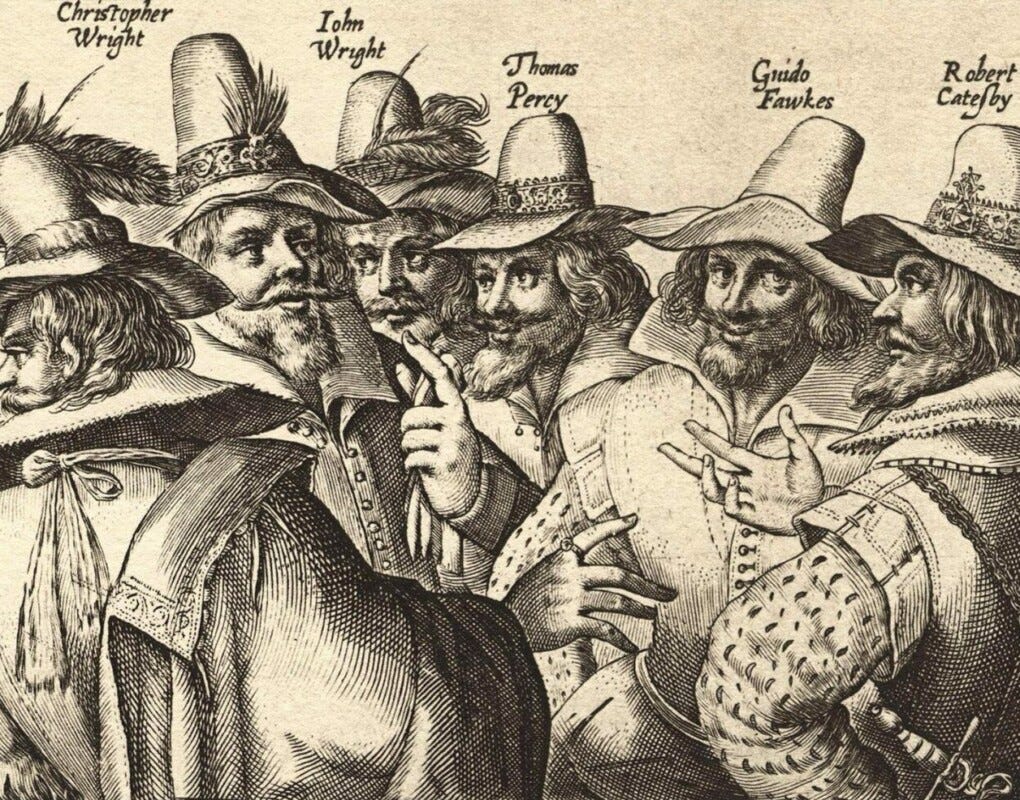
Robert Catesby planned it. Thomas Percy rented the cellar. Thomas Wintour recruited the men. Fawkes was the explosives expert. The technician. Not the architect.
When the plot failed and the state needed a face for Catholic treachery, a name to rally Protestant England around, a symbol to justify decades of surveillance—they chose Fawkes.
Not because he was most guilty.
Because he was most useful.
Fast forward 44 years.
January 30, 1649. Whitehall, London.
King Charles I kneels before an executioner. His head falls. Severed by the sword of parliamentary justice.
The man who brought him here stands nearby in black. Oliver Cromwell.
He believed he was saving England from tyranny. He believed God guided his hand. He believed the Commonwealth would bring righteousness.
Within a decade he would rule as Lord Protector. Unelected. Unchallengeable. Governing through force and surveillance.
The thing he destroyed, he became.
Two men. Two failures. Two mechanisms.
Fawkes shows how symbols work. How systems manufacture meaning. How failed acts become permanent myths. How humans vanish beneath masks.
Cromwell shows how machinery works. How reform becomes bureaucracy. How victory becomes blindness. How the righteous become repressive without noticing the crossing.
Together they reveal the dual nature of system control: meaning and machinery. Myth and method. Story and structure.
Neither requires evil individuals.
Only logic. Fear. Prestige. The patient grinding of human complexity into system simplicity.
THE MAN WHO DISAPPEARED
Guy Fawkes was born in 1570 in York. Protestant family. His father died when he was eight. His mother remarried a Catholic. Fawkes converted.
He fought in the Spanish Netherlands for Catholic forces. Became an explosives expert. Skilled. Competent. Loyal.
When Robert Catesby recruited him for the Gunpowder Plot, Fawkes was the practical choice. Not the leader. Not the ideologue. The specialist.
The plan: blow up Parliament during the State Opening. Kill the king and the Protestant elite. Install a Catholic monarch. Restore the faith to England.
It failed. One conspirator sent a warning letter to a Catholic lord. The authorities searched the cellars. Found Fawkes. Found the barrels.
Fawkes gave a false name: John Johnson. He held out under interrogation for days. When he broke, he gave up names. Tried. Convicted. Sentenced to be hanged, drawn and quartered.
January 31, 1606. Weakened by torture, he climbed the scaffold. He jumped from the gallows before the noose could tighten.
A final act of control. Denying the executioners their full spectacle.
That’s the man.
The man is not what survived.
What survived was the symbol the state needed.
Within weeks, Parliament declared November 5th a national day of thanksgiving. A celebration of the plot’s failure. A reminder of Catholic danger. A justification for repression.
“Guy Fawkes Night.” Bonfires. Effigies burned. Children chanting:
“Remember, remember, the fifth of November, Gunpowder, treason and plot.”
The story became liturgy. The failed plot became proof of ongoing threat. Fawkes—not Catesby, not Percy, not any actual leader—became the face of treason.
Why Fawkes?
Because he was caught in the cellar. Hands on the fuse. The image was perfect: the Catholic saboteur lurking beneath Protestant England, ready to destroy everything.
THE SYMBOL THAT KEEPS WORKING
The English state turned Fawkes into:
Fear architecture. Proof that threats lurk everywhere, even beneath your feet.
Unity myth. Protestant England against Catholic conspiracy.
Control justification. Surveillance, oaths of loyalty, repression of Catholics.
For two centuries “Guy Fawkes” meant one thing: traitor.
Catholic families couldn’t hold office. Couldn’t vote. Couldn’t own land in many areas. The anti-Catholic laws—justified by the Gunpowder Plot—persisted until the 19th century.
Fawkes didn’t create those laws.
He became their justification.
Then the symbol flips.
By the 20th century Fawkes stops being the villain. He becomes the anti-authoritarian icon.
The Guy Fawkes mask—stylized, anonymous, instantly recognizable—appears in protests worldwide. Occupy movements. Hacker collectives. Democracy demonstrations.
Same face. Opposite meaning.
Now Fawkes represents resistance to power. Anonymity against surveillance. The individual against the state.
A symbol created by the state to justify control becomes a symbol of resistance to that control.
Through it all, the man remains invisible.
No one protesting in a Fawkes mask knows his biography. His beliefs. His failures. His actual role in the conspiracy.
They know the symbol.
The symbol works.
THE MECHANISM OF MEANING
This is what systems do with symbols:
FAILED ACT
    ↓
STATE CAPTURES NARRATIVE
    ↓
SYMBOL MANUFACTURED (fear, unity, loyalty)
    ↓
SYMBOL OUTLIVES CONTEXT
    ↓
CULTURE REAPPROPRIATES SYMBOL (rebellion, anonymity)
    ↓
SYMBOL CONTINUES WORKING—FOR WHOEVER HOLDS IT
Fawkes is almost pure symbol. There’s barely any “man” left to discuss.
History erased him. The state replaced him with a story. Culture replaced the story with a meme.
The meme—four centuries later—still generates meaning. Still coordinates action. Still shapes how people understand power and resistance.
The most dangerous symbols are the ones everyone can claim and no one can verify.
THE MAN WHO BECAME THE SYSTEM
Oliver Cromwell was born in 1599 in Huntingdon. Minor gentry. Puritan conviction. Deeply religious.
He believed in Providence. That God acted through history. Through chosen instruments. Through righteous action.
When the English Civil War began in 1642—Parliament vs. King Charles I—Cromwell raised a cavalry troop. He was a natural military leader. Disciplined. Strategic. Ruthless when necessary.
By 1645 he commanded the New Model Army. England’s first professional military force.
They won. Marston Moor. Naseby. Preston.
Cromwell believed he was fighting tyranny. The king claimed absolute power. The king suppressed Parliament. The king endangered Protestant England.
Cromwell won.
Charles I was tried. Convicted. Executed. The monarchy abolished. England became a Commonwealth. A republic, theoretically governed by Parliament.
Within months, the mechanisms shifted.
Victory high.
Winning the war created momentum—and blindness.
The army that defeated the king couldn’t just disband. It had power. It had discipline. It had righteousness on its side.
It had enemies: Royalists. Catholics. Levellers demanding democracy. Scots. Irish.
Every threat demanded response. Every response required force. Every use of force required justification.
Cromwell—believing himself God’s instrument—provided both.
The optimization trap.
Order became more important than liberty. Stability more important than pluralism.
Cromwell’s government banned theater. Immoral. Banned Christmas celebrations. Pagan. Banned dancing, gambling, swearing.
Imposed Puritan morality through law.
Dissent became dangerous. Questioning became treason. Names became files. People became categories. Decisions were written in ledgers, not hearts.
When your cause is righteous, your methods become invisible. When you believe God guides you, accountability vanishes. When the machinery exists, it demands continued justification.
It finds it.
By 1653 Cromwell dissolved Parliament. He ruled as Lord Protector. Unelected. Unchallengeable. Governing through the army.
He wasn’t king. He refused the crown.
Functionally? More powerful than Charles I ever was.
MORAL CAUSE
    ↓
EMERGENCY POWERS
    ↓
NORMALIZED EXCEPTION
    ↓
PERMANENT CONTROL
THE CONQUEST OF IRELAND
Ireland, 1649. Majority Catholic. Royalist sympathies. Seen by Cromwell as a threat to the Commonwealth and Protestant England.
Cromwell led an invasion. Sieges of Drogheda and Wexford. Massacres of garrisons. Civilian deaths. Massive land confiscations. Catholic population displaced. Property seized. Rights stripped.
Historians debate motives and numbers.
The mechanism is visible: once violence is justified as necessary and righteous, it expands. Temporary measures become policy. Punishment becomes routine.
A system learns to do harm efficiently.
Cromwell believed he was doing God’s work. The system believed it was securing stability.
The result was generational trauma Ireland carries still.
THE RESTORATION—AND THE GHOST
Cromwell died in 1658. Natural causes. His son briefly succeeded him. The Commonwealth collapsed within two years.
Charles II—son of the executed king—returned from exile. The monarchy was restored. The experiment ended.
Cromwell?
Exhumed. Tried posthumously. Hanged. Beheaded. His head displayed on a spike for 24 years.
The man who executed a king was symbolically executed by the restored crown.
Here’s the twist: Cromwell’s machinery survived.
The New Model Army model influenced future British military. The centralized bureaucracy persisted. The precedent—that Parliament could challenge kings, that rulers were not absolute—remained.
The man was punished.
The system continued.
TWO MECHANISMS, ONE LESSON
Fawkes and Cromwell show the dual engines of system control.
Fawkes = Meaning
How symbols work. How states manufacture myths. How failed acts become permanent narratives.
Cromwell = Machinery
How reform becomes bureaucracy. How righteousness becomes repression. How systems consume their founders.
Put together:
Symbols without machinery = empty gestures, forgotten quickly.
Machinery without symbols = pure force, fragile without legitimacy.
Symbols + Machinery = durable control.
The state that burned Fawkes in effigy for centuries used the symbol to justify the machinery of surveillance and repression.
The Commonwealth that Cromwell built used the machinery to enforce the symbol of godly rule.
Both failed eventually.
Both mechanisms persist.
THE WITNESS POSITION
Clean stories want:
Fawkes = villain or hero.
Cromwell = tyrant or liberator.
The witness resists that comfort.
Fawkes was a conspirator trying to commit mass murder. Also: a man erased by the symbol placed on him, used by power structures for centuries.
Cromwell was a liberator who broke monarchical tyranny. Also: a ruler who imposed religious law through force, who enabled mass violence, who became the thing he opposed.
Both are true.
Systems and individuals shape each other. Sometimes the shaping produces justice. Sometimes it produces horror.
Often: both.
The mechanism doesn’t judge. It names. It says: look at how this works. Look at what it does to humans. Look at how it persists.
Then: choose.
WHAT OUTLIVES THE MAN
Four centuries after Fawkes died, his face is everywhere. Protests. Movies. Memes. Commerce.
Four centuries after Cromwell died, his methods persist. Emergency powers rarely sunset. Surveillance programs seldom shrink. Public punishment doesn’t disappear—it changes platforms.
The machinery adapts faster than memory.
Neither man would recognize what they became.
Fawkes, the Catholic conspirator, is now an anarchist icon.
Cromwell, the Puritan reformer, is now studied as a case in how revolutions devour their children.
Stories harden faster than facts. Bureaucracy forgets that humans built it. Once a symbol works, it stops needing the person it came from.
We—living now—inherit both. The masks and the methods. The myths and the mechanisms.
Can you see them working?
Can you see when a symbol is being manufactured?
Can you see when machinery is being normalized?
Can you see the moment reform crosses into repression?
The mechanisms don’t announce themselves. They arrive quietly.
They say: necessary. Temporary. Righteous.
Then they stay.
The mechanism:
INDIVIDUAL ACTS
    ↓
SYSTEM CAPTURES NARRATIVE (meaning)
    ↓
SYSTEM BUILDS MACHINERY (method)
    ↓
NARRATIVE + MACHINERY = DURABLE CONTROL
    ↓
INDIVIDUAL DISAPPEARS
    ↓
MECHANISMS PERSIST
The man with the gunpowder became a mask anyone can wear.
The man who broke the king became a machine anyone can inherit.
The men are gone.
The mechanisms remain.