

The Distance Between Decision and Consequence
How we engineered consequence out of view — and what happens when it returns.

Every system we depend on is built to hide something: consequence.
The farther goods travel, the less we feel the cost of moving them—until something interrupts the route.
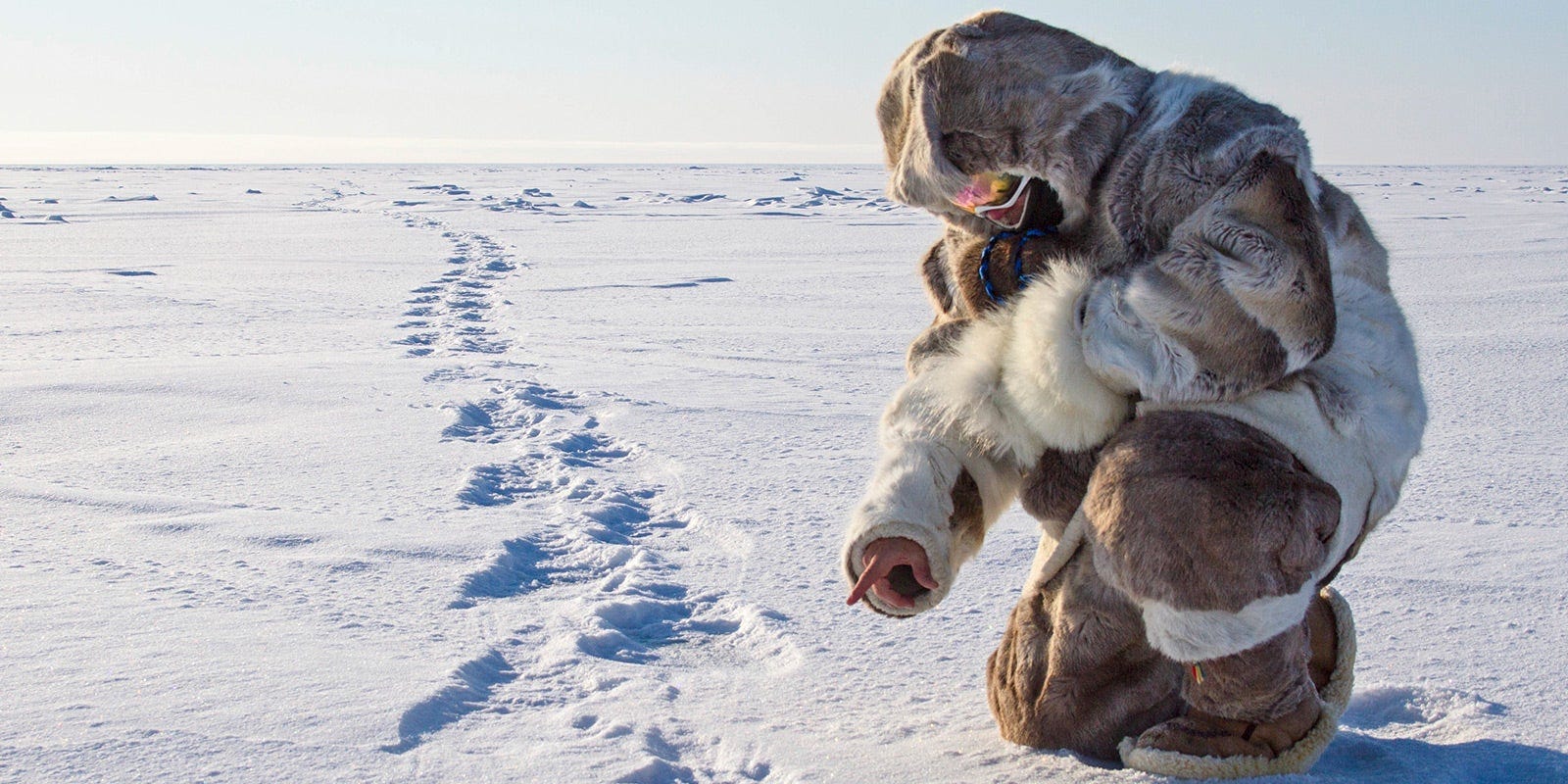
Northern Canada. Pre-dawn. The temperature is minus forty.
A Nendaaghe Dena hunter crouches on the ice, reading the surface. A specific shade of blue-gray means thickness. A particular creak underfoot means danger. The difference between those two readings is the difference between crossing and drowning.
There is no system between this man and that ice.
No app. No warehouse. No algorithm absorbing the error before it reaches him.
The Nendaaghe Dena do not manage resources. They answer to them.
The hunt fails or it doesn’t. The river runs or it doesn’t. The salmon return or they don’t. You eat what you catch. You survive the winter you prepared for.
There is no distance between decision and consequence.
This is not poverty. This is not backwardness.
This is close to the original operating condition of human systems.
Reality, direct. Feedback, immediate. Consequence, personal.
No insulation.
The first fracture came from distance.
Chang’an, China. Sometime in the ninth century. A merchant loads bolts of silk onto a camel—each bolt worth a year of agricultural labor, each bolt light enough to carry across a continent. The animal smells of dust and dung. The silk smells of nothing. That’s part of the point. Silk compresses enormous value into almost no weight. That is what makes it worth carrying six thousand miles.
The merchant cannot see the Venetian market. Cannot feel the signal that demand is shifting. Cannot know that last month’s price is not this month’s price.
The Silk Road did not erase consequence. It stretched it.
Risk is no longer immediate. Consequence can be delayed.
But it cannot be eliminated. Loss still has an owner. If the caravan fails in the Taklamakan desert—raiders, thirst, a broken axle—someone in Chang’an loses the investment. If the Samarkand market collapses, the merchant in Constantinople takes the blow. The road extended consequence across space and time.
It never severed it.
The system was still tethered to reality. Just by a longer rope.
But distance does something else.
It allows decisions made in one place to propagate into consequences no one present can fully see.
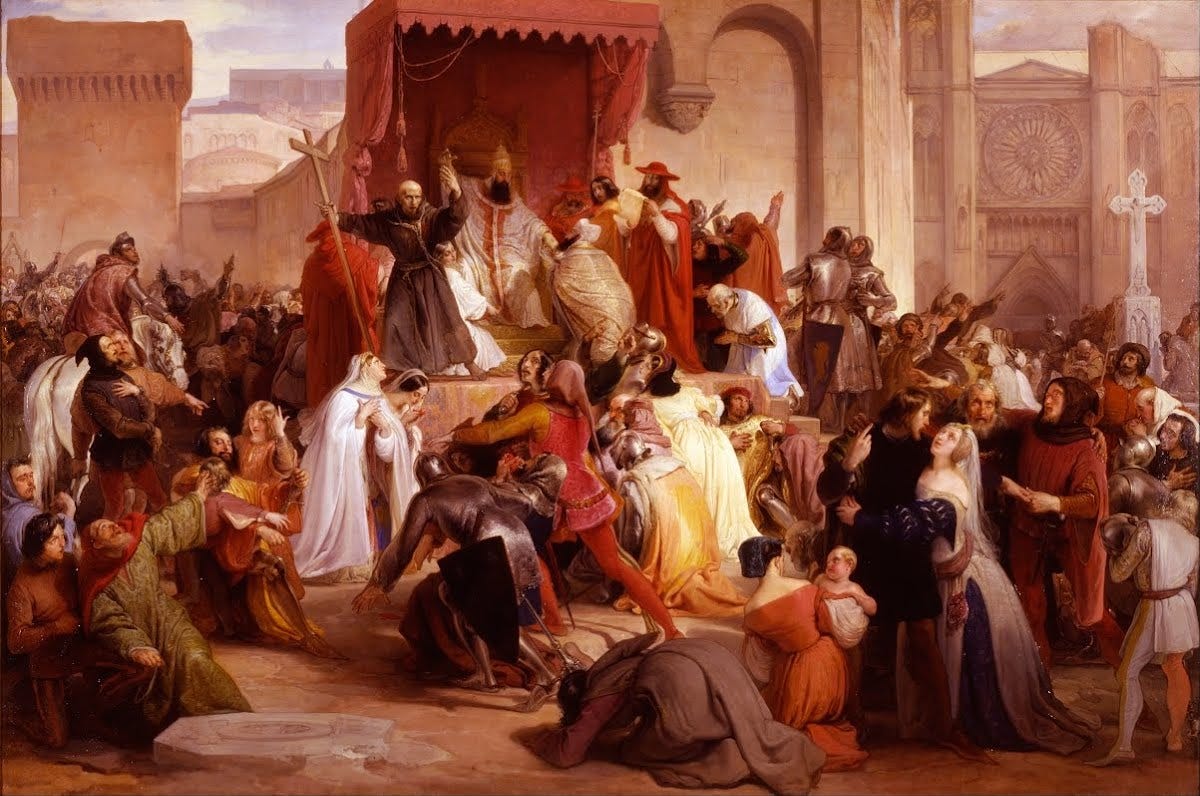
Clermont, France. November 27, 1095. Pope Urban II stands in an open field—the cathedral cannot hold the crowd—and calls for a campaign to reclaim Jerusalem. The air is cold. The crowd is enormous. People are weeping. Some are shouting Deus vult—God wills it—before he finishes speaking.
A speech. A crowd. A field in France on a November morning.
It set armies in motion that would reshape trade, fracture empires, and redraw the relationship between Europe and the eastern Mediterranean for the next four centuries.
The people in that field could not see the system they had just entered.
The Silk Road did not just stretch consequence.
It amplified it.
Once consequence can travel, it no longer needs to be large at the point of origin.
But amplification does not guarantee alignment.
Once consequence can travel, it can also drift.
A century after Urban II called the First Crusade, another force set out for Jerusalem. They never arrived. Debt to Venetian financiers redirected them first to the Christian city of Zara. Then, in 1204, to Constantinople itself—the seat of Eastern Christendom, the city that anchored half the known world’s trade.
They sacked it. Looted the Hagia Sophia. Melted the bronze horses of the hippodrome for coin. Burned entire quarters to the ground.
A campaign launched to reclaim Jerusalem ended by destroying the city it depended on.
No one standing in that field in Clermont intended this. The participants could not see the system they had entered. Incentives traveled faster than intention.
Consequence did not just amplify.
It drifted.
By the time the Ottomans arrived, two and a half centuries later, the system was already weakened from within.
Then came the moment the rope snapped.
Constantinople. May 29, 1453. Pre-dawn.
The Ottoman guns have been firing for fifty-three days. The largest cannons ever cast. Stones weighing 1,200 pounds. The sound carries across the Bosphorus and rolls back again. The walls—walls that held for a thousand years, walls that turned back Avars and Arabs and Bulgars and Vikings—are finally cracking.
At dawn, the Janissaries breach the section near the Blachernae Palace.
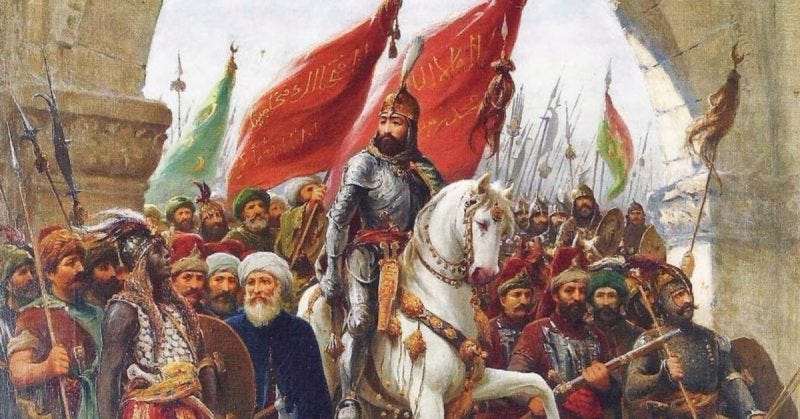
By noon, Sultan Mehmed II rides through the Gate of St. Romanus on a white horse.
He is twenty-one years old. He dismounts at the Hagia Sophia, reaches down, picks up a handful of earth, and pours it over his turban. Humility before God. The most powerful man in the Mediterranean, pouring dirt on his own head.
Inside the church, the mosaics catch the afternoon light. Gold. Twelve centuries of it.
The merchant networks of Venice and Genoa don’t mourn the mosaics. They don’t have time. They understand the mechanism immediately:
The rope just got cut.
The route that carried silk, spice, and dye from Asia to Europe—the rope that connected consequence to decision across six thousand miles—now runs through a city that belongs to Mehmed.
Pepper is worth more than gold by weight. Nutmeg sells for what a laborer earns in a month. And the route to everything runs through a gate he controls.
The Venice merchants don’t negotiate. Negotiation requires leverage. They have none.
They reroute.
Portugal was already working the African coastline. Not because they were visionaries. Because they had no choice.
Small ships. Caravel-rigged, shallow-drafted, built for coastlines. Creeping south along a continent they couldn’t see the end of.
1488: Bartolomeu Dias rounds the Cape. His crew mutinies. He turns back. But he’s seen it—the water bending east. The bottom of Africa.
1498: Vasco da Gama reaches Calicut. The spice market. No Ottoman tax.
1492: Columbus, sailing west for Spain, looking for anything that wasn’t the Ottoman route, finds a hemisphere he doesn’t recognize and goes to his death publicly insisting it was Asia.
Within fifty years of Constantinople’s fall, European ships are in the Caribbean, Brazil, the Indian Ocean, and the coast of West Africa.
One city closed. Two oceans opened.
The Ottoman empire—sitting on the most valuable real estate in the history of global commerce, the hinge between every land route connecting Asia and Europe—watched as history slowly sailed around them. The gate still stood. The chains still crossed the Golden Horn. The tax collectors still sat at their tables.
The ships just stopped coming.
This is what happens when you cut a rope: the people holding it find another way to tie it.
The system reroutes. It does not stop.
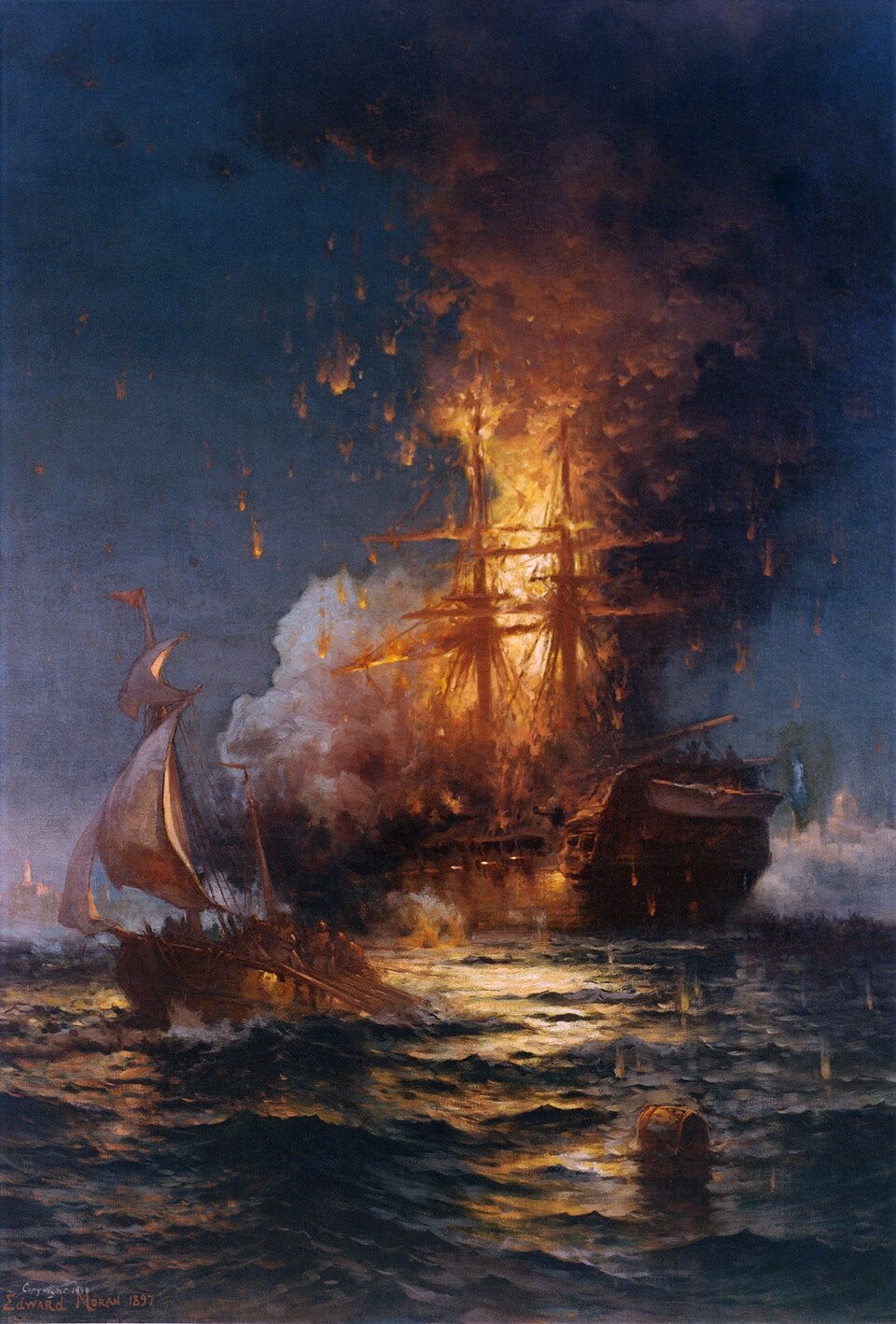
USS Philadelphia burning at the Battle of Tripoli Harbor during the First Barbary War in 1804
But rerouting takes time.
In the interval—between the old route closing and the new one functioning—something moved into the gap.
The Barbary corsairs understood the interval better than anyone.
Picture this: A Genoese merchant vessel, 1540, running west through the Strait of Sicily. Wind behind her. The captain is calculating—days to Marseille, value of the cargo, weather holding. Then someone at the bow shouts. A shape on the horizon. Low, fast, oared. No flags yet.
The captain knows before the flags appear.
Algiers. Tunis. Tripoli. Salé. Nominally Ottoman. Operationally autonomous. Sitting directly on the Mediterranean—the highway European shipping still needed, because not everything could go around Africa.
The corsairs didn’t close the sea.
They didn’t need to.
Persistent low-level threat changes behavior as effectively as blockade.
Raid a vessel: profit. Capture the crew: ransom. Threaten a coastal town: tribute. Let the threat be credible enough, and you don’t need to succeed every time. You need only be possible.
The shape on the horizon is enough.
Insurance premiums rose. Naval escorts became standard. Coastal towns relocated inland—whole villages picking up and moving a mile from the shore. Lloyd’s of London traces part of its early development to merchants pooling against exactly this kind of persistent threat.
A hundred corsair ships changed the economics of ten thousand merchant voyages.
Not by winning. By waiting. By being present at the narrow place where ships had to pass.
For three centuries, consequence kept returning—pulled back into contact at every passage where ships could not avoid it.
Eventually, some states stopped paying.
The United States—new, distant, and dependent on Mediterranean trade—refused tribute and sent warships instead. The Barbary Wars were not about piracy alone. They were about restoring flow. When persistent friction raises the cost of passage high enough, systems do not adapt indefinitely.
They project force at the chokepoint.
Constraint is negotiated until it isn’t. Then it is confronted.
But even force cannot remove constraint. It can only manage it.
Then something genuinely new happened.
Consequence was not delayed. Not stretched. Not returned at chokepoints. Not confronted at gunpoint.
It was engineered out of view.
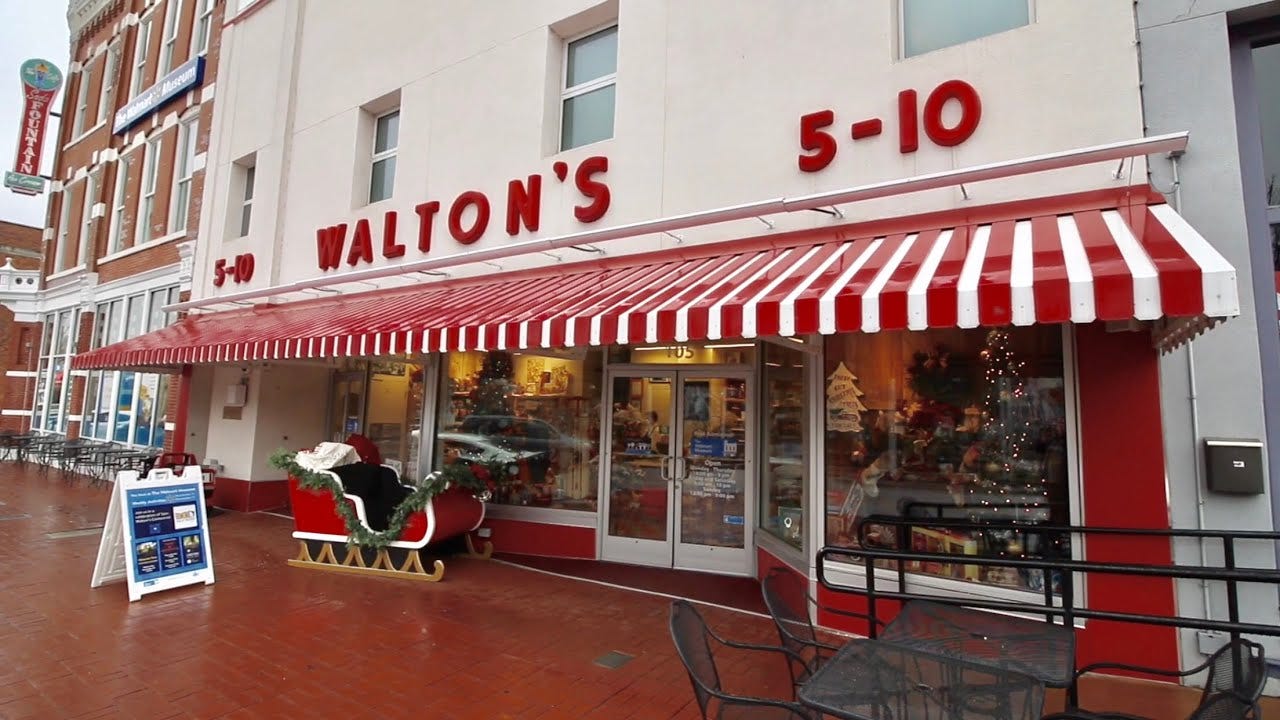
Bentonville, Arkansas. 1962.
Sam Walton opens a store. Five-and-dime, Main Street, small town. Nothing remarkable about the storefront.
But behind the storefront: a system.
Not a store for products. A store for flow. Walton is obsessed with the gap between demand and supply—the friction, the delay, the moment the shelf sits empty. He eliminates it. Real-time inventory before computers can fully support real-time inventory. Distribution centers positioned like military installations. Suppliers integrated directly into the restocking cycle.
Walk in. The shelf is full.
What you don’t see: the factory in Shenzhen where the workers making that product earn wages Walmart’s purchasing team deliberately drove as low as possible. The container ship—thirty-thousand tons of steel, a crew of twenty-two—crossing the Pacific for three weeks. The distribution center in Kentucky running on skeleton margins, workers scanning barcodes at four in the morning. The supplier who accepted Walmart’s price because refusing meant losing 40% of revenue overnight.
The consequence is real. The consequence is just somewhere else.
Walmart built a layer between people and the systems those people depended on.
Amazon did the same thing, faster, and called it Prime.
Jeff Bezos did not build a store. He built an insulation layer.
Why would a system designed to eliminate friction care where the friction went? It wasn’t designed to care.
Two-day delivery means the consequence of your decision—the labor, the fuel, the warehousing, the third-party seller in a garage in Ohio, the last-mile driver working without benefits—arrives before you can feel any of it.
No friction. No delay. No moment where you touch the reality beneath the interface.
Click—consequence absorbed before it can be felt. The package arrives.
The distance between decision and outcome has been compressed to nothing. But that compression is performed, not real. The consequence exists. It’s just been routed away from the person making the decision.
This is the completion of what started on the Silk Road.
Not extended consequence.
Hidden consequence.
The hunter reading ice at minus forty.
The merchant loading silk onto a camel in Chang’an.
The captain watching the shape on the horizon off Sicily.
All of them inside consequence, one way or another—tethered to it, feeling it, pricing it into every decision.
Amazon and Walmart extended it further than ever. They built a world where consequence could be permanently delayed, distributed, and hidden—where a billion decisions could be made every day by people who felt none of them.
You ordered from them. So did I. The insulation layer works because we wanted it to.
Until the route narrows.
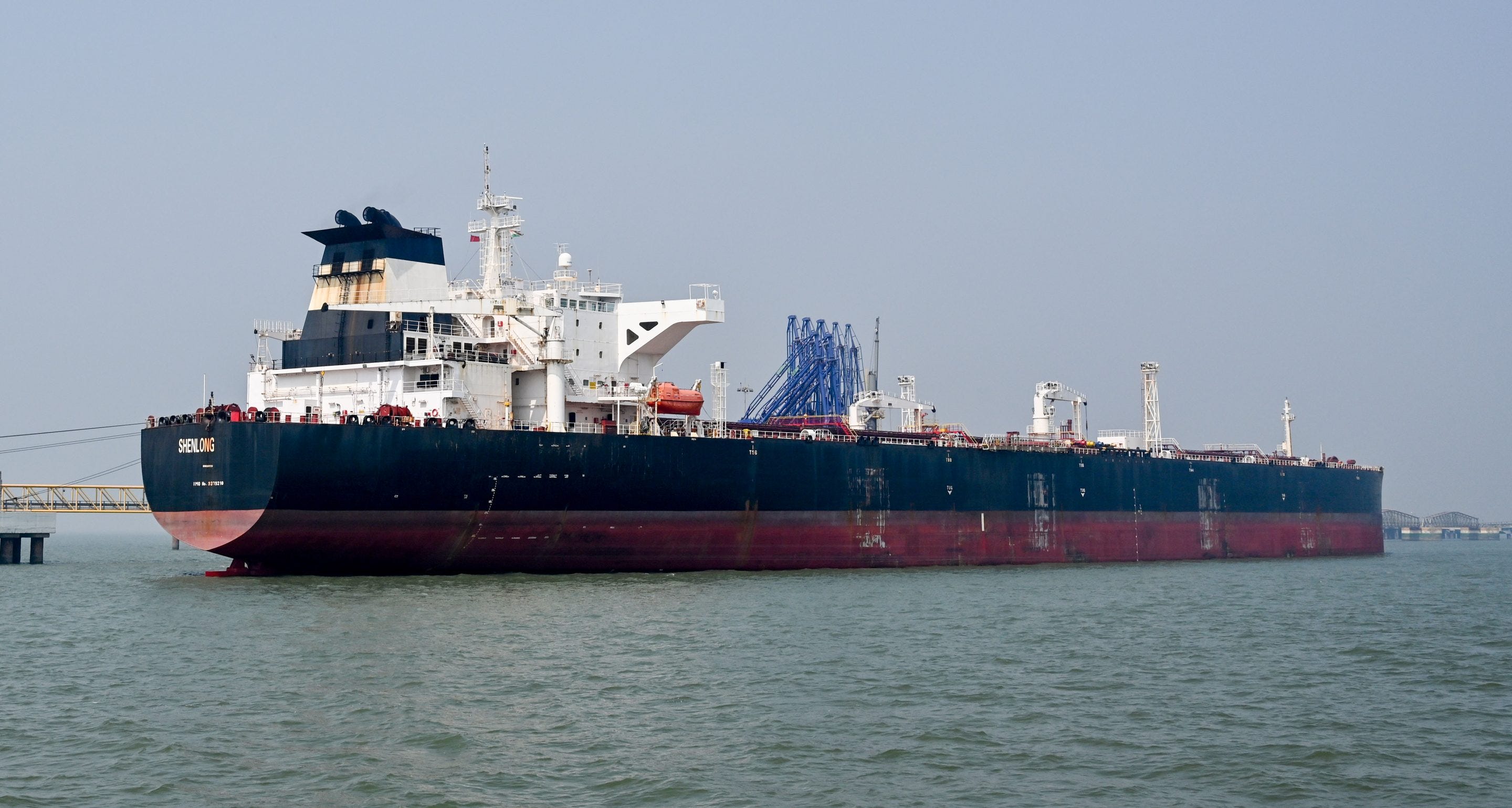
Strait of Hormuz. 2026.
A supertanker—a Very Large Crude Carrier, a quarter-million tons of steel and oil, longer than the Chrysler Building is tall—sits anchored in the Gulf of Oman and does not move. The captain has been on the radio for hours. No clearance. No escort. No information. Just the instruction that arrived days ago: do not attempt transit. The owners are not willing to risk a $100 million vessel on a whim or a chance. Nor are the insurance underwriters. All it takes is a credible threat. And the system freezes.
The strait is twenty-one miles wide at its narrowest point. The navigable shipping lane: two miles.
In normal times: roughly 130 ships a day pass through. Twenty million barrels of oil. About a fifth of global seaborne energy trade. Liquefied natural gas. Containers. Tankers running to China, India, Japan, South Korea, and the power plants that keep European cities lit. Billions of dollars a day, threading through a two-mile lane.
When conflict threatens that passage, traffic collapses. Insurance spikes. Oil prices surge. The system feels the constraint immediately—not because of what has been destroyed, but because of what cannot move.
The insulation layer—the one Amazon and Walmart perfected, the one that made consequence invisible to a billion consumers—fails at twenty-one miles of water between Iran and Oman.
And consequence returns.
Not as abstraction—as price.
Jet fuel spikes. Aluminum rises. Fertilizer rises. The price of a box of pasta in a German supermarket now contains the risk premium of a passage someone has decided to control.
In Algiers in 1600, the corsairs understood this logic precisely. Sit at the narrow place. Be credible. Let the insurance premiums do the work.
The Barbary deys charged tribute. Their successors charge passage fees. Lloyd’s adjusted premiums in 1620. Lloyd’s adjusts them again now. The mechanism is the same. The geography is different.
Identical logic.
Every civilization in this sequence believed it had escaped consequence.
The Silk Road merchant believed distance insulated him from distant markets. It didn’t—it amplified his decisions, so that a speech in a field in France could shatter cities four centuries later.
The Venetian merchant after Constantinople believed rerouting would restore stability. It did, until the corsairs sat down at the next narrow place.
Amazon and Walmart built systems so efficient their users cannot feel the infrastructure—until a container ship gets stuck sideways in the Suez Canal, and suddenly everyone learns what “just-in-time” means.
Systems do not fail at their strongest point. They fail where reality cannot be abstracted.
A narrow strait. A local force. An elemental fact.
The hunter on the ice never lost contact with consequence.
Modern systems engineered that contact out of view.
And at the chokepoint, it returns. Not as punishment. Not as justice.
As physics.
Water flows downhill. Ropes under tension snap. Routes that close get routed around. Chokepoints that can be held, get held.
There is no distance between decision and consequence.
There is only the illusion of distance—sustained by infrastructure, labor, capital, and complexity—until two miles of navigable water reminds you.
The merchant in Chang’an loaded his silk onto the camel and could not see the Venetian market.
Mehmed poured earth on his head and could not see the Atlantic.
Sam Walton opened his store on Main Street and could not see the strait.
The supertanker sits anchored in the Gulf of Oman, engines idling, cargo going nowhere.
The route narrows. It always does.
And someone is always waiting there.
The arc this essay runs:
Zero insulation — Nendaaghe Dena hunter on the ice at minus forty. No distance between decision and consequence.
Extended — The Silk Road. Consequence stretched across continents but never severed.
Amplified — Urban II at Clermont, 1095. A speech in a field. Four centuries of consequences no one in that crowd could see.
Drifted — The Fourth Crusade, 1204. Set out for Jerusalem. Ended by sacking Constantinople. Incentives traveled faster than intention.
Severed — Constantinople, 1453. Already weakened. One city closes. Two oceans open.
Persistent friction — Barbary corsairs. A shape on the horizon off Sicily. They never closed the Mediterranean — they made every transit price in the risk.
Hidden — Amazon and Walmart. Consequence not delayed. Engineered invisible.
Returned — Strait of Hormuz, 2026. Twenty-one miles. The supertanker sits anchored. The insulation layer fails.
Same mechanism. A thousand years.
Good one. A couple of related 'consequential' posts you might like (not mine): https://no01.substack.com/p/the-gazillion-dollar-oops and https://warwickpowell.substack.com/p/war-energy-and-the-cunning-of-entropy.