

OVER THE RAINBOW SYSTEMS
How an American fairy tale diagnosed governance collapse a century early

Editor’s Note: This is a long-form systems essay. It is not a film review, a nostalgia piece, or a plot analysis. It reads The Wizard of Oz as infrastructure—one Americans have ritualized for seventy years without acting on what it teaches.
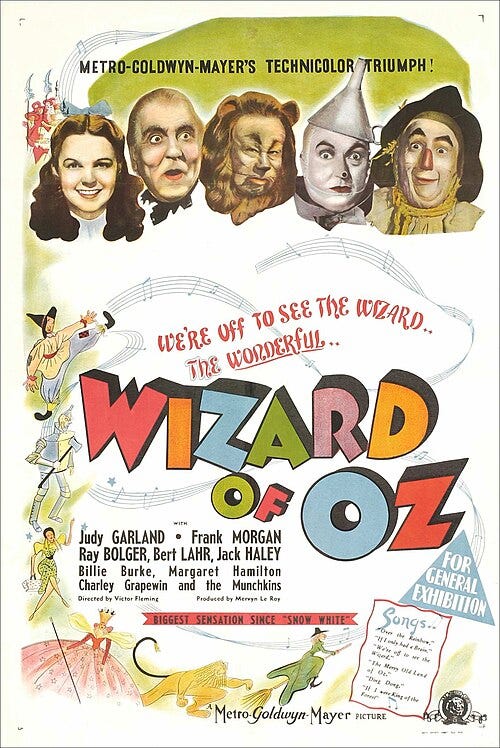
The Kansas sky turned green first.
Not the pale spring green of new wheat. Not the gray-green of summer thunderheads building over flat land. This was the green of bruised metal, of something fundamental breaking in the atmosphere itself. Dorothy Gale stood in the doorway of her uncle’s farmhouse watching the color drain upward from the horizon, watching the wind stop moving, watching the chickens go silent in a way that meant the world had changed its rules.
She didn’t know she was about to enter a diagnostic diagram of how systems substitute appearance for function. She didn’t know the cyclone would deposit her inside a political allegory of monetary policy, governance theater, and the precise mechanisms by which authority maintains legitimacy after losing capacity. She just knew the sky had turned the wrong color and her body understood something her mind hadn’t yet processed: survivability had ended and something else had begun.
The farmhouse lifted.
THE THANKSGIVING TRANSMISSION
Every year in November, American families gather around television screens to watch this happen again.
Thanksgiving evening. Dishes cleared or still being washed. The living room dark except for the television’s glow. Families arranged on couches in configurations that repeat annually with small variations: grandparents in recliners, children on the floor, parents in between. The same chairs. The same movie. The sepia Kansas slowly bleeding into Technicolor Oz.
The movie plays every Thanksgiving because in 1956 someone at CBS decided holiday programming should mean spectacle. The choice was commercial. The mechanism became something else. Year after year, the broadcast carved a groove in American collective memory. By the time you were old enough to question it, the tradition was already older than your parents.
These are not individual responses; they are participation in a transmission pattern that has repeated for seventy years. The movie isn’t entertainment anymore. It’s infrastructure. A Yellow Brick Road through American collective memory.
And every year, millions of families watch Dorothy learn that she already possessed what she needed, watch the Wizard revealed as a fraud, watch the silver-turned-ruby slippers carry her home, and nothing changes. Everyone returns to their lives the next day. The diagnosis is transmitted. The mechanisms continue to operate.
L. Frank Baum’s 1900 novel The Wonderful Wizard of Oz operates as something more precise than fairy tale: a systems manual for how civilizations construct coherence from illusion, how they maintain governance through visual logic rather than material capacity, and how citizens navigate infrastructure designed to certify authority rather than deliver function. The story functions whether you read it as fantasy or as Populist political satire of 1890s American monetary policy. This isn’t coincidence. The mechanisms are the same.
Dorothy’s journey from Kansas to Oz and back maps the pattern civilizations follow when they cross the threshold from human-scale systems into symbolic superstructures that consume capacity faster than they generate it. The Yellow Brick Road. The Emerald City. The Wizard behind the curtain. These aren’t just story elements. They’re diagnostic markers of how systems fail while appearing to function.
And they’re operating at full acceleration in 2025.
THE SILVER QUESTION
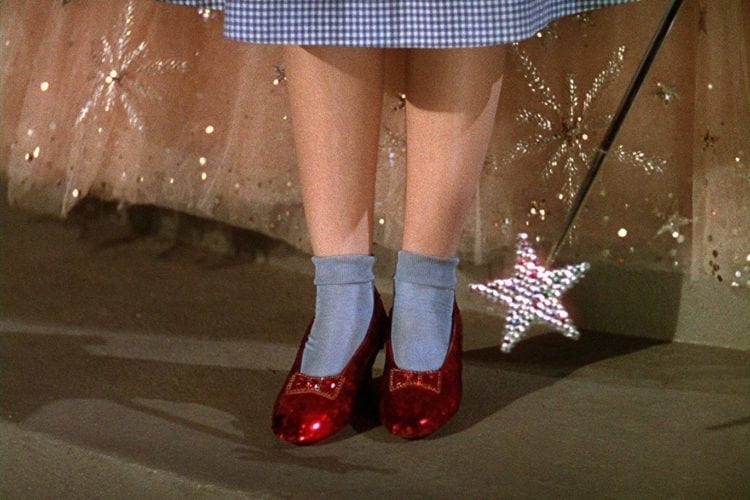
Dorothy stands in Munchkinland wearing dead woman’s shoes.
The house has killed the Wicked Witch of the East: killed her by falling, by displacement, by the simple physics of Kansas infrastructure landing on Oz politics. The Good Witch of the North tells Dorothy the shoes are now hers. In Baum’s original text, these shoes are silver. Not ruby. Not the Technicolor spectacle added for the 1939 film. Silver.
In 1900, America was convulsing over the currency question. Gold standard versus bimetallism. The debate wasn’t abstract: it determined who could borrow money, who could pay debts, who could survive harvest failures and bank panics. Eastern financial interests wanted gold. Western farmers and laborers wanted silver. The Populist movement made “Free Silver” its central demand, arguing that expanding the money supply would ease the debt burden crushing rural America.
Dorothy, ordinary girl from Kansas farm country, suddenly possesses silver shoes she doesn’t know how to use. She walks the Yellow Brick Road (gold standard) wearing silver (Populist monetary policy) without understanding she already has what she needs to get home. The system tells her she lacks what she already possesses.
This is Mechanism #1: Systems blame individuals for conditions created by the system itself.
A person enters a system that appears coherent (yellow road, emerald city, wizard who grants wishes) and the system immediately diagnoses them as deficient. You lack a brain. You lack a heart. You lack courage. The diagnosis creates dependency. The dependency sustains the system.
Dorothy begins walking toward the Emerald City to ask the Wizard for something she could have done herself at any point. This isn’t story convenience. This is how governance works when it has lost the capacity to deliver function but maintained the authority to certify legitimacy.
OZ AS COMPASS: THE PHASES OF EXTRACTION
Oz is not a kingdom. Oz is a compass.
But the compass in Oz does not map space. The compass maps how extractive systems move through time.
This essay argues that The Wizard of Oz endures not because it offers comfort, but because it encodes (spatially, ritually, and emotionally) the lifecycle of extractive systems: how they begin in violence, justify themselves through legitimacy, enforce compliance through fear, and allow escape only at the individual level.
Capitalism and colonialism don’t spread randomly. They move in directions of function: origin, legitimation, extraction, enforcement, exit. Oz stages that cycle spatially. Each witch occupies a position in this cycle. Each represents not a moral category but a stage in how authority operates when it exists primarily to extract.
East: violence forgotten.
North: legitimacy without capacity.
West: enforcement without belief.
South: knowledge without power.
Center: projection without coordination.
EAST: ORIGIN / FORGOTTEN VIOLENCE
The Wicked Witch of the East is already dead when the story begins. Crushed by Dorothy’s house: her authority collapsed through impact, not rebellion, and no one in Oz mourns her passing.
The East represents the origin point of extraction, the moment when force creates the conditions that later phases will inherit and rationalize.
Dorothy takes the dead Witch’s shoes. The inheritance is automatic. No one questions whether she should have them. The story moves forward as if acquiring power through displacement is simply how things work.
NORTH: LEGITIMACY / MORAL COVER
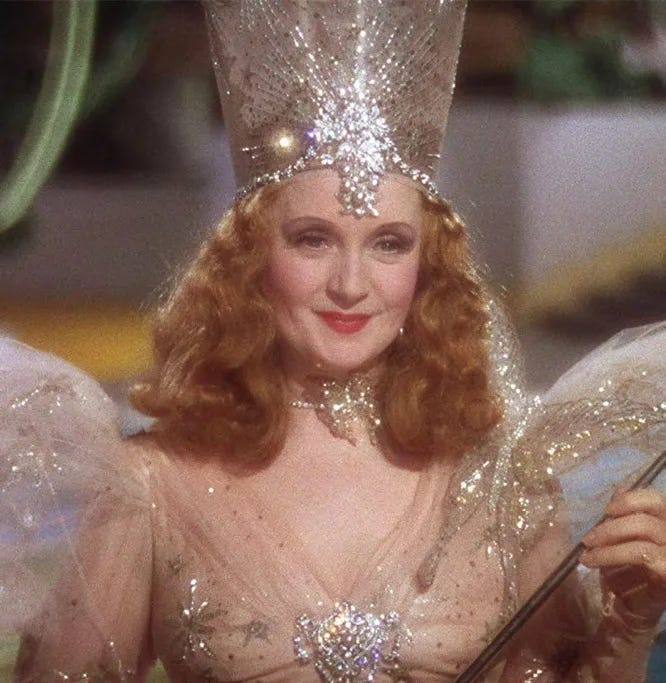
The Good Witch of the North appears immediately after the violence.
The North produces moral cover: rules, norms, and legitimacy that explain extraction without having the power to stop it. Law. Civilization narratives. “Rules-based order.” Colonialism becomes “progress.” Capitalism becomes “the only system that works.” Violence becomes “development.”
The Good Witch of the North is good precisely because she never enforces anything. She maintains her moral authority by never exercising material power. She can afford to be good because someone else does the violence.
WEST: ENFORCEMENT WHEN LEGITIMACY FAILS
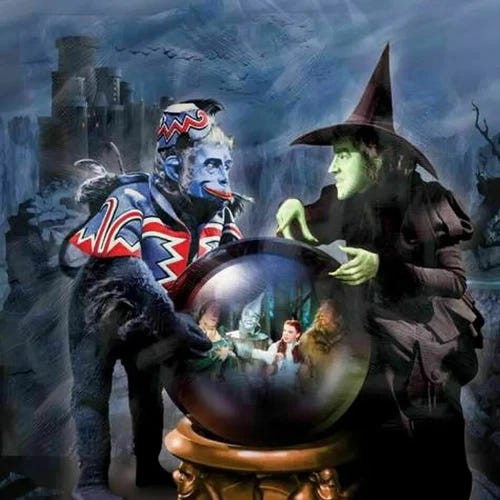
The Wicked Witch of the West rules where the sun sets.
The West is capitalism at full maturity. Industrial discipline. Forced labor. Supply chains. The West is what extractive systems become when legitimacy fails and the only thing holding them together is coercion.
But the West is also precision execution. The West enforces standards it didn’t write. The West implements systems designed elsewhere with extreme discipline. The West controls force, labor, punishment, and the West is necessary to the system even as the system disavows it.
The West is where extraction becomes honest. When legitimacy no longer persuades, the West shows what was always operating beneath the moral cover the North provided.
The Witch of the West is what extractive systems become when they can no longer justify themselves. She is not a deviation from the system. She is the system’s terminal phase.
SOUTH: KNOWLEDGE THE SYSTEM CANNOT MONETIZE
Glinda (the Good Witch of the South) appears only at the end.
She knows the solution from the beginning but does not intervene until the system has exhausted itself. The South does not fix systems. The South teaches people how to leave them.
This is what extractive systems cannot absorb. Informal economies. Indigenous knowledge. Mutual aid. The South holds what capitalism cannot monetize without destroying. The South operates below certification. The South survives when larger systems fail.
Glinda waits. She does not prevent Dorothy from walking the Yellow Brick Road, nearly dying in the poppy field, being enslaved by the Witch. The South waits until you’ve exhausted yourself believing you needed the center’s permission. Then the South teaches you what you already had.
CENTER: PROJECTION WITHOUT COORDINATION
The Wizard occupies the center: the Emerald City at the hub where all roads converge.
But the Wizard is not a direction. He is financial abstraction. Administrative spectacle. Institutional authority without capacity.
Capitalism always pretends there is a center. There never is. There is only management of belief. The Wizard is theater substituting for capacity, projection that coordinates nothing, authority that exists to certify extraction it cannot perform and legitimize enforcement it will not acknowledge.
This compass structure isn’t about morality. It’s about function: how extractive systems distribute roles as they phase from violence through legitimation through enforcement to collapse.
Oz is capitalism told as a compass: born in violence, justified by legitimacy, enforced through fear, and escaped only by those who stop asking permission.
THE YELLOW INFRASTRUCTURE
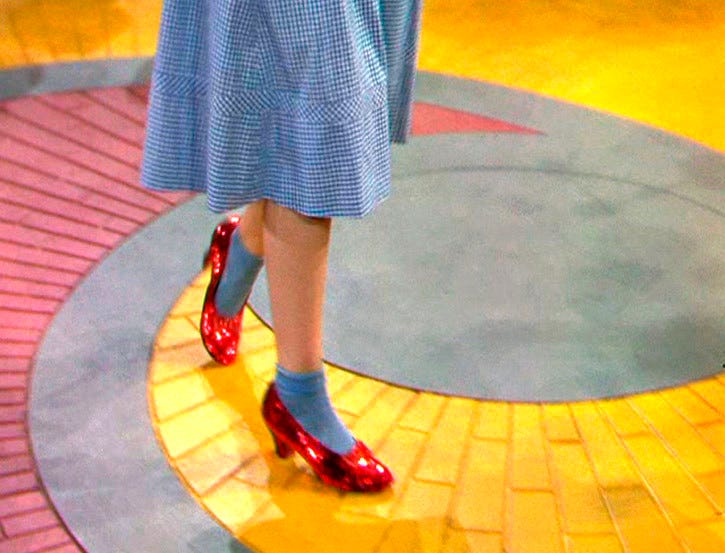
The Yellow Brick Road is everywhere in Oz.
On screen, the Yellow Brick Road is one of cinema’s most iconic images. Pure saturated yellow spiraling through Technicolor landscape. The yellow is impossible, artificial, clearly manufactured, but it reads as magical rather than suspicious.
In the political reading, the Yellow Brick Road represents the gold standard: the economic infrastructure that the Eastern establishment insisted must be preserved regardless of who it crushed. The road is yellow. The road is brick. The road is hard, inflexible, and leads to a single destination. This is infrastructure designed for control, not for survivability.
Dorothy walks the road because it’s the only visible path. The road provides legibility: you can see where it goes, you can measure your progress, you can believe you’re advancing toward your goal. But legibility and function are not the same thing. The road takes Dorothy toward the Wizard, but it doesn’t take her home. The infrastructure serves the system’s needs, not the participant’s needs.
This is how infrastructure that appears navigable becomes functionally extractive.
THE COMPANIONS: DIAGNOSING DEFICIENCY
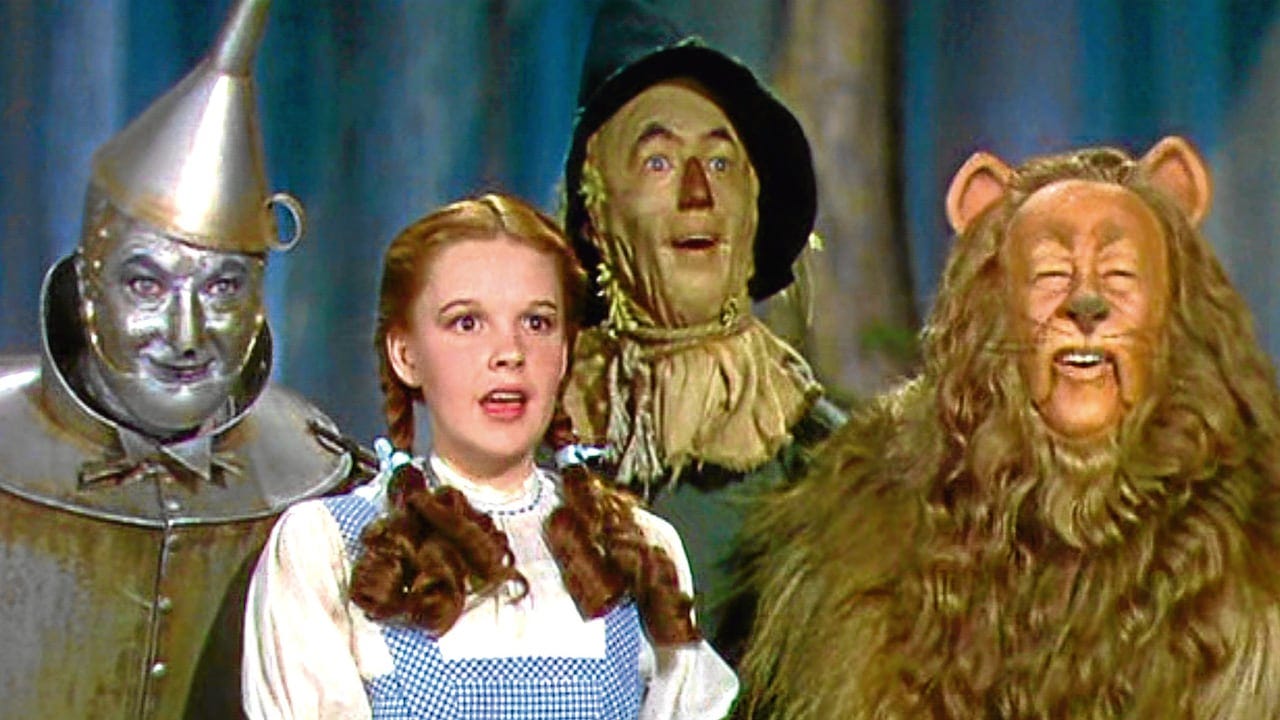
Dorothy meets the Scarecrow first. He hangs on a pole in a Munchkin farmer’s field. He can move, he can speak, but he believes he has no brain. The farmer who made him told him so. The system certified his deficiency at the moment of creation.
Except the Scarecrow solves every problem the group encounters. He devises the plan to cross the deadly poppy field. He suggests how to approach the Winkies. He reasons through obstacles with immediate, practical intelligence. But he cannot recognize this capacity as a brain because the system has not certified it as such. He has the function. He lacks the credential.
In the political allegory, the Scarecrow represents American farmers: people the Eastern establishment considered ignorant, backward, incapable of understanding economics or governance. The farmers possessed immense practical capacity. But they lacked Yale degrees, lacked the certification that Eastern money considered legitimate. The system told them they were stupid. They internalized the diagnosis.
The Tin Woodman appears next, rusted in the forest. He was once human, in love, planning to marry. The Wicked Witch of the East cursed his axe, causing it to slip and cut off his limbs one by one. A tinsmith replaced each lost part with tin until the Woodman was entirely metal. Now he believes he has no heart.
Except he weeps for crushed beetles. He mourns the ants he accidentally steps on. He demonstrates continuous, active compassion throughout the journey. But he cannot recognize this capacity as a heart because the system has not certified it as such.
The Cowardly Lion completes the trio. He roars to frighten Dorothy and Toto, then immediately apologizes, explaining he’s actually a coward: terrified of everything despite being King of Beasts.
Except he fights the Kalidahs. He crosses the chasm. He attempts to battle the Winged Monkeys when they attack. He demonstrates continuous, active bravery throughout the journey. But he cannot recognize this capacity as courage because the system has not certified it as such.
This is how systems create deficiency through diagnosis, then offer certification as solution.
Each companion already possesses what they seek. But capacity doesn’t matter if the system won’t certify it as legitimate. The Wizard becomes necessary not because he can create brains, hearts, or courage, but because he can issue the credential that makes existing capacity socially recognizable.
You have skills but need the degree. You have experience but need the certification. You have capacity but need the system’s permission to acknowledge that capacity as real.
THE EMERALD APPARATUS
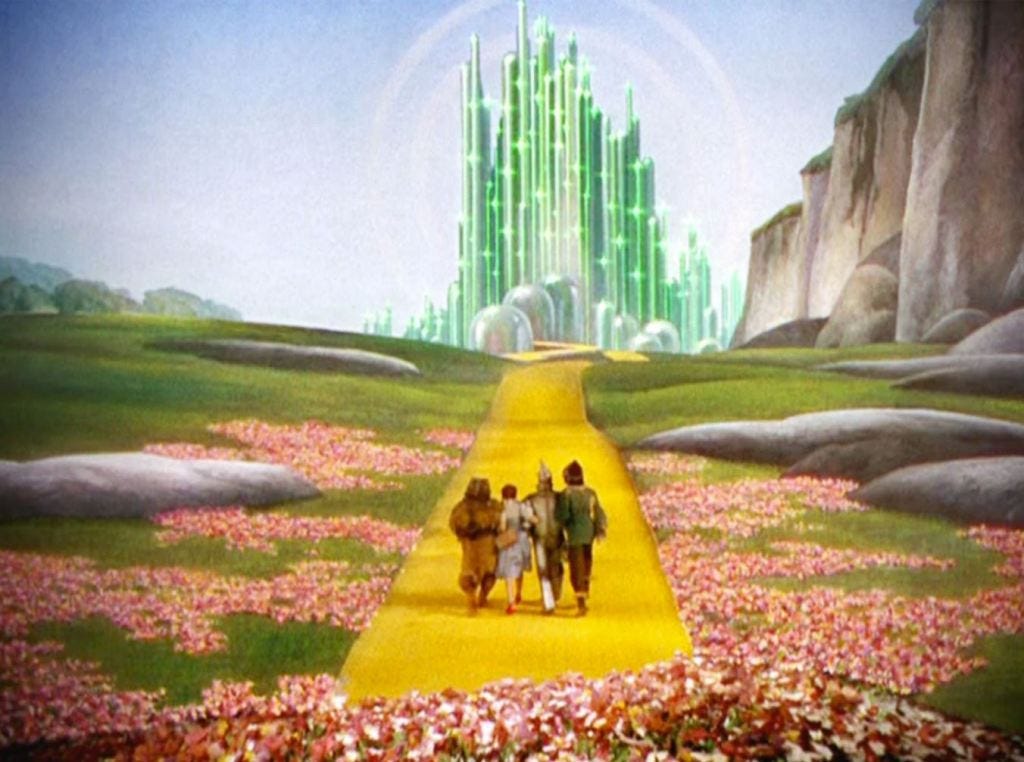
The Emerald City appears green from a distance.
The travelers approach massive green gates. The Guardian explains they must wear spectacles before entering. Green spectacles. Locked onto their heads with a key only the Guardian holds.
With the spectacles on, everything appears emerald. The apparatus creates the appearance it claims to reveal.
In Baum’s novel, this is explicit: the city isn’t actually green. The spectacles make it appear green. But no one removes the glasses because removing them is forbidden, because the Guardian holds the key, because questioning the apparatus is positioned as dangerous rather than investigative.
This is how systems maintain coherence through mandatory perception frameworks.
You can’t see the Emerald City without the glasses. You can’t participate in Oz without accepting the system’s visual logic. The apparatus becomes prerequisite for participation, and participation becomes evidence that the apparatus works.
The apparatus mediates perception. Perception becomes reality. Reality reinforces the apparatus.
THE WEST: WHERE EXTRACTION BECOMES HONEST
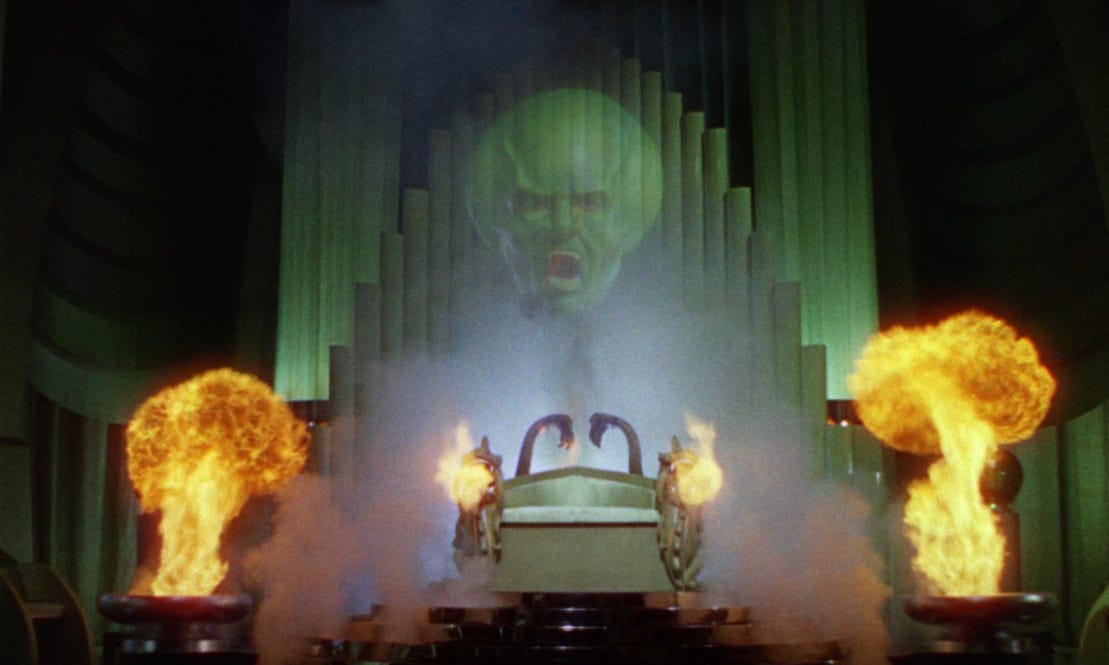
They wait for days to see the Wizard. Eventually they gain audience with the giant floating head wreathed in flame and smoke.
And the Wizard agrees to grant their wishes (brain, heart, courage, home) on one condition.
They must kill the Wicked Witch of the West.
The Wicked Witch of the West is not the antagonist of Oz. She is the phase of the system the center cannot admit it requires.
The Witch lives where the sun sets, in the terminal phase where legitimacy has failed and only enforcement remains. She commands the Winkies, who work her fields and factories under compulsion. She controls the Winged Monkeys through a golden cap: enforcement reduced to mechanism, violence that obeys whoever holds the command. She has coercive force. But she has no legitimacy. She cannot certify anyone’s brain, heart, or courage as real. She cannot end Dorothy’s quest.
Only the Wizard can do that. Only the center can provide certification.
This is how systems externalize their inability to function: by demanding petitioners first solve the problem that proves the system unnecessary.
If Dorothy and her companions can kill the Witch themselves, they don’t need the Wizard’s protection. But the framing makes the Wizard appear essential. He’s the one who will grant legitimacy to their success, even though he contributed nothing to achieving it.
The Witch deploys the Winged Monkeys, creatures bound by the golden cap to obey whoever commands them. This is not a story about a people. It is a story about what systems do to people when obedience becomes the condition of survival. The monkeys are force reduced to mechanism, violence stripped of identity, loyalty, and meaning. They have no ideology. They have no allegiance. They obey whoever controls the mechanism that commands them.
Eventually Dorothy throws water to put out a fire threatening the Scarecrow. The water hits the Witch. The Witch melts: screaming, dissolving, reduced to a puddle and a pointed hat. The Winkies celebrate their freedom. Dorothy and her companions take the broomstick as proof and return to the Emerald City.
And nothing changes.
The Witch is dead. The enforcement arm has been severed. But the Yellow Brick Road still routes participants toward centralized authority. The Emerald City still gleams. The Wizard still delays. Eliminating enforcers does not dismantle systems that require enforcement.
THE WIZARD: AUTHORITY WITHOUT CAPACITY
They return with the broomstick. The Wizard delays. Makes excuses.
Then Toto pulls the curtain aside.
The curtain pulls back and there’s Frank Morgan, older man in a suit, pulling levers and speaking into a microphone, operating the machinery that created the floating head.
“Pay no attention to that man behind the curtain!” he shouts, and his voice booms from the giant head even as you’re watching him produce the effect. The mechanism is exposed and still functioning simultaneously.
The Wizard is revealed as a man with no authority except what projection gave him. A balloonist who drifted into Oz by accident decades ago and used circus tricks to convince people he had power. Theater instead of capacity. Appearance instead of substance.
What’s crucial is what happens next.
The Wizard doesn’t lose power when exposed. The curtain doesn’t collapse the system. Instead, the Wizard pivots: he offers to give the companions what they want anyway, not through magic but through certification.
He presents the Scarecrow with a diploma from a university that doesn’t exist. He presents the Tin Woodman with a silk heart-shaped cushion stuffed with sawdust. He presents the Lion with a medal for bravery.
The Scarecrow receives his diploma and immediately begins speaking in mathematical terminology and Latin phrases: demonstrating the same intelligence he always had, now certified and therefore recognizable. The Tin Woodman receives his silk heart and immediately feels loving. The Lion receives his medal and immediately feels brave.
The objects are worthless. The certification transforms their self-perception.
This is how authority survives exposure: by substituting certification for function once legitimacy is questioned.
The Wizard promises Dorothy he’ll take her back to Kansas in his balloon. They prepare for departure. Then Toto jumps out of the basket chasing a cat. Dorothy runs after him. The balloon lifts off without her.
The system fails even at certification theater. But Dorothy continues to believe the system should function, even as it fails.
THE SOUTH: KNOWLEDGE WITHOUT POWER
Glinda appears after the Wizard’s departure.
She tells Dorothy something that restructures the entire narrative: the ruby slippers could have taken her home at any time. She just had to click her heels together three times and wish to be there.
Dorothy is furious. “Why didn’t you tell me before?”
Glinda’s answer: “Because she wouldn’t have believed me. She had to learn it for herself.”
Glinda is saying: I watched you walk the Yellow Brick Road knowing it was unnecessary. I watched all of this happen because you needed to believe the system was necessary before you would accept that it wasn’t.
Dorothy possessed the solution before the journey began. The entire quest (the Yellow Brick Road, the Emerald City, the Wizard, the Witch, the certification theater) was unnecessary. The infrastructure and authority structures she navigated existed to prevent her from recognizing what she already possessed.
In the political allegory, this is the Populist argument concentrated: the people already have what they need to solve their problems. The system exists to prevent them from recognizing this.
The ruby slippers (silver in the book, monetary policy metaphor translated into Technicolor spectacle) carry her home. She lands in Kansas and the shoes are gone: fallen off in transit, disappeared, no longer accessible. The moment she uses the solution outside the system’s controlled narrative, the solution itself becomes unavailable for others.
This is how systems allow individual exits while ensuring those exits don’t threaten systematic control.
Dorothy escapes. The Scarecrow becomes ruler of the Emerald City. The Tin Woodman becomes ruler of the Winkies (the people the Witch formerly enslaved, now governed by someone who believes his capacity to care was granted by a fraud rather than inherent all along). The Lion becomes King of the Forest.
Nothing in Oz changes. The Wizard’s deception is known but not prosecuted. The Witch is dead but the Winkies now answer to new authority. The enforcement mechanisms remain available to whoever holds them next. The Emerald City remains emerald because people keep wearing the spectacles.
She wakes in her bed. Everyone is gathered around her. She says: “There’s no place like home.”
The movie ends.
OVER THE RAINBOW REALITY
This isn’t metaphor. It’s architecture.
The Emerald City is every platform that requires you to accept its metrics before you can participate. The Yellow Brick Road is every algorithm that promises connection while serving extraction. The Wizard is every authority that maintains legitimacy through appearance rather than capacity.
The East is where extraction begins with violence that later gets forgotten. The North is every system that certifies legitimacy without delivering outcomes. The West is enforcement when legitimacy fails. The South is what persists when larger systems fail.
The Winged Monkeys are enforcement reduced to mechanism: any violence systematized, any compliance made conditional. The companions are every person told they lack what they already possess.
Social media platforms promise connection while extracting data to serve advertiser needs. Governments promise security while pointing to external threats that justify why they cannot deliver services.
Each is Oz at digital speed. Each is capitalism told as a compass: born in violence, justified by legitimacy, enforced through fear, and escaped only by those who stop asking permission.
THE KANSAS THRESHOLD
Dorothy returns home and is glad to be there.
Not because Kansas is superior to Oz. But because Kansas operates at human scale. You can see the sky without spectacles. You can navigate without following infrastructure that serves extraction. You can recognize your own capacity without requiring certification from distant authority.
The contrast isn’t between good Kansas and bad Oz. The contrast is between systems that acknowledge their limits and systems that exist primarily to extract.
Kansas doesn’t pretend to be emerald. Kansas doesn’t diagnose you as deficient and offer certification as solution. Kansas doesn’t occupy a phase in an extractive compass. Kansas is flat, austere, legible.
This is what persists when extractive systems fail: human-scale environments where perception doesn’t require apparatus, local knowledge that doesn’t need external certification, capacity that doesn’t depend on authority’s permission to be recognized as real.
The cyclone that lifted Dorothy into Oz was displacement: the shock that occurs when existing systems cross the threshold from function into extraction. The silver-turned-ruby slippers that brought her home were recognition of capacity that existed all along.
You already have what you need. The system exists to prevent you from recognizing this. The curtain is always available to be pulled aside. The question is whether you’ll believe what you see when the Wizard is revealed, or whether you’ll accept the diploma he offers afterward.
The question is whether the tradition will remain ritual or become recognition.
Because recognition without action is not awareness. It is rehearsal.
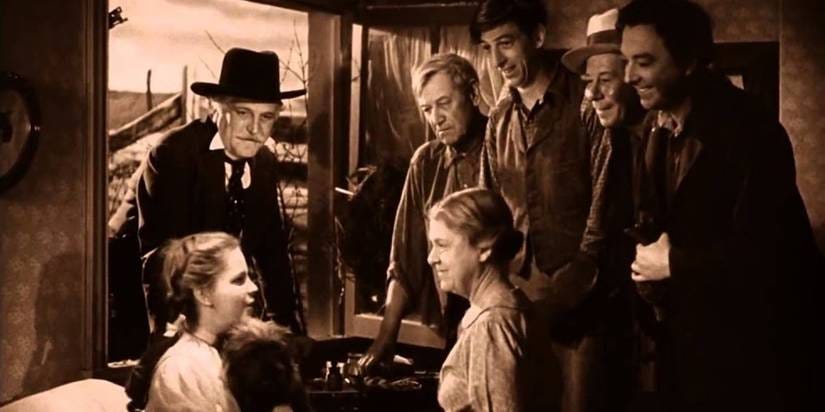
Dorothy chose Kansas.
The Scarecrow chose the throne in the Emerald City: ruling over people who still wear spectacles, still walk the yellow road, still believe the greenness is real.
The Tin Woodman chose to govern the Winkies: the people freed from the Witch’s enforcement, now subject to someone who believes his capacity to care was granted by a fraud rather than inherent all along.
Your family chose tradition: the annual witnessing without the annual naming.
All options are available. Only one acknowledges that the storm turned the sky green because something fundamental was breaking.
The Yellow Brick Road is still there. The Emerald City still gleams. The Wizard still grants audiences. The compass still turns. But none of it functions except to extract.
Oz is capitalism told as a compass: born in violence, justified by legitimacy, enforced through fear, and escaped only by those who stop asking permission.
Over the Rainbow Systems reads The Wizard of Oz not as a fairy tale or a political allegory, but as a lifecycle diagram of extractive power—one that Americans have ritually rewatched for seventy years without acting on what it teaches.
I recently read the Wizard of Oz for the first time to my daughter. Afterward, I searched the internet for an analysis like this and found the wikipedia which does hold some food for thought. But this in-depth article - published shortly after I began looking, by you whom I was already following - is exactly the type of analysis I was seeking. Thank you.