


From “Manifest Destiny” to modern globalization—the story changes, the mechanism doesn’t.
THE STORY THAT MADE CONQUEST FEEL HOLY
Philadelphia. 1872. Centennial Exhibition planning.
Committee reviewing artwork for display. John Gast’s painting: “American Progress.”
The image:
A woman floating westward. Flowing white gown. Star on forehead. Book in hand. Telegraph wire trailing behind her.
Below her: covered wagons, settlers, railways, farms spreading across landscape.
Behind her (east): cities, civilization, light.
Ahead of her (west): darkness, buffalo, Indigenous peoples fleeing.
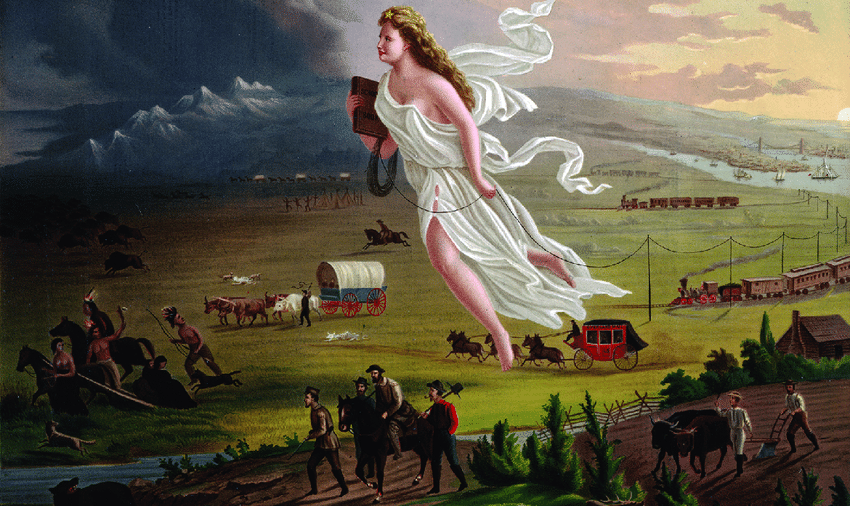
John Gast's iconic 1872 painting American Progress
The painting doesn’t show conquest.
It shows inevitability.
Not soldiers attacking. Not violence. Not theft.
Just progress. Moving. Glowing. Destined.
This was Manifest Destiny’s visual grammar:
Not: “We are taking land through force.”
But: “History itself wants this. We are instruments of destiny. The light moves west because that’s what light does.”
The phrase appeared 1845. Journalist John O’Sullivan:
“Our manifest destiny is to overspread the continent allotted by Providence for the free development of our yearly multiplying millions.”
Not conquest. Destiny.
By 1872, the story had won.
Indigenous nations crushed. Mexican territory annexed. Transcontinental railroad complete. Land distributed through Homestead Acts.
The painting celebrates what already happened—and promises more.
This essay isn’t about 1845.
It’s about how that story never stopped. Just changed clothes—and still runs our systems today.
From frontier expansion to “development zones.” From civilizing missions to “nation-building.” From Manifest Destiny to “inevitable globalization.”
Different vocabulary. Same operating system.
FEAR LOOP: CREATE DANGER, THEN PROMISE SAFETY
The historical version:
1830s-1890s. The frontier narrative.
“The West is wild. Dangerous. Lawless. Savage.”
Newspaper accounts:
Indian raids (often exaggerated or fabricated)
Lawless territories (requiring civilization)
Wilderness dangers (needing taming)
The message: Expansion isn’t aggression. It’s protection.
Settlers need safety. Railroads need security. Progress needs defending.
Andrew Jackson’s Indian Removal Act, 1830.
Official justification: “For their own protection.”
Indigenous nations in Southeast: thriving, farming, governing, adopting written constitutions.
But the story said: “They’re endangered by white settlement. Must relocate for safety. West of Mississippi will be permanent Indian territory.”
Reality: Forced marches. Trail of Tears. Thousands dead. “Permanent” territory seized within decades.
The mechanism:
Create fear → establish urgency → justify expansion → call it protection
Not: “We want their land.”
But: “They’re threatened. We’re helping. This is humanitarian necessity.”
The modern version:
1990s-present. The intervention narrative.
“Failed states. Terror zones. Ungoverned spaces. Security threats.”
The vocabulary shifted:
Not “savage wilderness.” Now “failed states.”
Not “civilizing mission.” Now “stabilization operations.”
Not “permanent Indian territory.” Now “security corridors.”
Iraq, 2003. Official justification:
“Weapons of mass destruction. Imminent threat. Saddam Hussein endangers region. We must protect.”
Reality: No WMDs. But oil fields secured. Reconstruction contracts distributed. Permanent military bases established.
The story after: “Bringing democracy. Stabilizing region. Protecting American interests.”
Afghanistan, 2001-2021. Justification evolves:
First: “Hunt al-Qaeda. Protect homeland.”
Then: “Nation-building. Women’s rights. Democracy.”
Finally: “Strategic interest. Counter-terrorism. Regional stability.”
Each story generates permission for staying.
Twenty years. Trillions spent. Taliban returns when troops leave.
But during those twenty years—lithium deposits mapped. Pipeline routes surveyed. Strategic positioning maintained.
None of this was only about greed or conspiracy. There were real fears, real debates, real complexities.
But the template still guided decisions—turning legitimate security concerns into justifications for expansion, extraction, control.
The mechanism identical:
Identify threat → create urgency → expand presence → call it protection → extract resources → maintain control
The “danger” justifies the expansion. The expansion creates new “dangers” requiring more expansion.
This is Fear Loop:
Terror → urgency → permission → expansion → new terror → more urgency
The system feeds itself.
OPTIMIZATION TRAP: LAND BECOMES A TOOL
The historical version:
Great Plains, 1870s-1890s.
Before: Buffalo herds numbering 30-60 million. Indigenous nations following seasonal migrations. Grassland ecosystem functioning for millennia.
The optimization question: “How do we maximize cattle production?”
Answer: Remove buffalo. They compete for grass.
Result:
Buffalo slaughtered systematically. Hides shipped east. Bones ground for fertilizer. Carcasses left to rot.
Not for food. For optimization.
By 1889: fewer than 1,000 buffalo remaining.
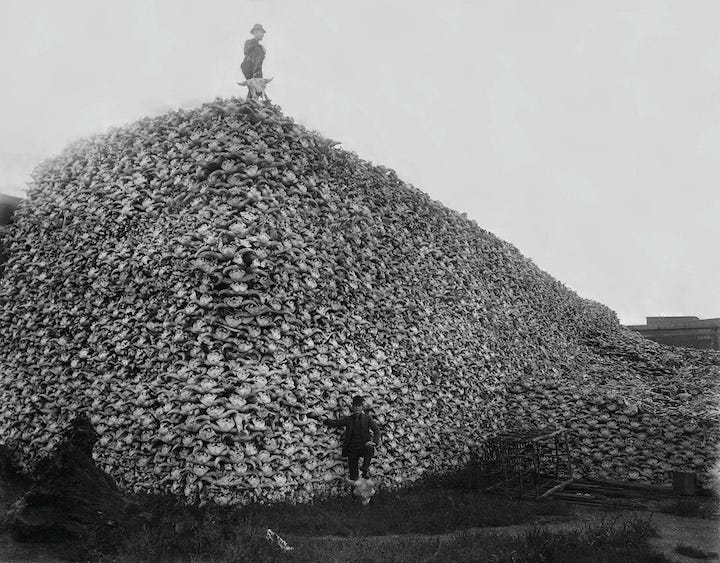
A 19th-century scene at Michigan Carbon Works: bison skulls collected by the thousands, destined to be turned into fertilizer.
General Philip Sheridan, 1875:
“Let them kill, skin, and sell until the buffalo is exterminated, as it is the only way to bring lasting peace and allow civilization to advance.”
The logic:
Buffalo = Indigenous food supply
No buffalo = forced settlement
Forced settlement = land available
Available land = cattle ranching = profit
Ecosystem becomes optimization problem.
Forests next.
Old-growth forests: complex ecosystems, Indigenous managed burns, biodiversity.
Optimization question: “How many board-feet per acre?”
Answer: Clear-cut. Replant monoculture. Maximize timber yield.
Result: Appalachian forests stripped. Pacific Northwest old-growth eliminated. Soil erosion. Species extinction. Watershed collapse.
But the numbers looked good. Output increased.
The mechanism:
Ask not: “Is this sustainable? Is this right? What are we destroying?”
Ask only: “Does this increase output? Does this maximize yield?”
This is Optimization Trap:
System optimizes for single metric (profit, production, control) while externalizing all costs (ecological, social, long-term).
The optimization succeeds. The system collapses. Just not immediately.
Now we ask the same question of rainforests, oceans, atmosphere.
The modern version:
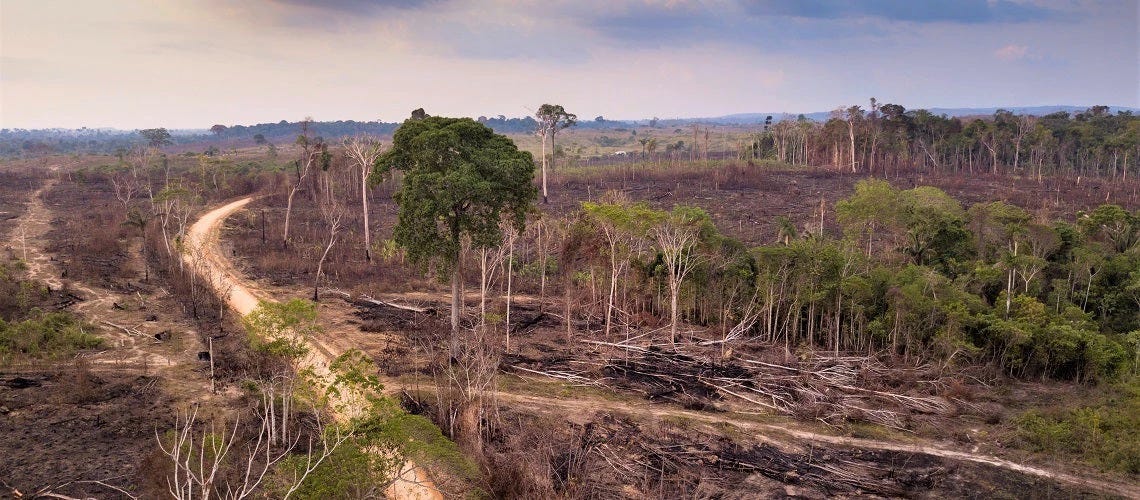
Trees cut and burned on an illegal dirt road to open land for agriculture and livestock in the Jamanxim National Forest, Para, Brazil.
Amazon rainforest, 2000s-present.
Before: Biodiversity hotspot. Carbon sink. Indigenous territories. Ecosystem regulating global climate.
The optimization question: “How do we maximize agricultural output?”
Answer: Clear rainforest. Plant soy. Raise cattle.
Result:
20% of Amazon deforested. Fire season smoke visible from space. Indigenous communities displaced. Species extinct. Carbon released. Rainfall patterns disrupted.
But:
Brazil becomes top soy exporter. Beef production soars. GDP increases.
The optimization succeeds—for the metrics being measured.
Lithium fields. Congo cobalt mines. Rare earth extraction.
The question: “How do we maximize battery production for electric vehicles?”
Answer: Strip-mine lithium in Chile, Bolivia, Argentina. Extract cobalt in DRC using child labor. Process rare earths in China with toxic waste.
Result:
Electric car production increases. “Green technology” advances. Climate goals theoretically achievable.
But:
Water tables poisoned in Atacama Desert. Congolese children mining in collapsed tunnels. Toxic lakes in Inner Mongolia. Indigenous communities displaced.
The metrics: optimized. The costs: externalized.
Once you’re asking “how to maximize,” you’ve already lost the real question: “should we?”
BUREAUCRATIC BLINDNESS: PAPER REPLACES REALITY
The historical version:
Land Office maps, 1850s-1890s.
The paper reality:
Territories labeled “unoccupied.” “Public domain.” “Available for settlement.”
The actual reality:
Lakota, Cheyenne, Arapaho, Comanche, Apache nations. Hunting grounds. Sacred sites. Seasonal migration routes. Functioning societies.
But the map said: empty.
So bureaucracy treated it as empty.
Homestead Act (1862): “Any citizen can claim 160 acres of unoccupied land.”
Definition of “unoccupied”: No European-style permanent structures. No fences. No deeds registered in U.S. land offices.
Indigenous presence: Invisible to paperwork. Therefore: didn’t exist.
The treaties:
Hundreds negotiated. Most broken. Some never intended to be kept.
The process:
Map shows “Indian territory”
Settlers pressure government
New treaty “purchases” or “relocates”
Map redrawn
Repeat
Fort Laramie Treaty (1868): Guarantees Black Hills to Lakota “for as long as the grass grows and the water flows.”
1874: Gold discovered in Black Hills.
1877: Treaty violated. Land seized. “For as long as the grass grows” lasted nine years.
The mechanism:
If the form says it exists → it exists
If the form doesn’t list it → it disappears
This is Bureaucratic Blindness:
Systems see only what paperwork documents. Reality outside forms becomes invisible.
The land office didn’t see nations. It saw acres. The treaties weren’t agreements between sovereigns. They were real estate transactions.
Paper replaced reality. Then enforced itself.
Lands lost by the Native Americans In the US (1776-1930)
Now the paperwork lives in satellites, cadastral databases, development banks.
The modern version:
Development zones, 2000s-present.
The paper reality:
“Underdeveloped areas.” “Economic opportunity zones.” “Infrastructure gaps.”
The actual reality:
Functioning informal economies. Community networks. Traditional land use. Homes without deeds but occupied for generations.
Cambodia, Ethiopia, Honduras:
Governments create “economic land concessions.” Foreign investors receive paperwork granting control.
The forms say: “Unused land. Available for development.”
Reality: Smallholder farms. Communal forests. Villages without formal title.
Result: Communities evicted. “Development” proceeds. GDP increases. People displaced to urban slums.
The paperwork was correct. The forms said the land was available.
Satellite maps and “empty space.”
Google Earth shows borders, roads, cities. Informal settlements appear as blank space.
Urban planners see: “Underutilized land. Prime for development.”
Reality: Thousands living there. Markets operating. Communities functioning. Just not formally registered.
Result: Bulldozers arrive. Residents evicted. “Slum clearance” or “urban renewal” announced.
The map didn’t show them. Therefore: they weren’t there.
If you’re not on the form, you don’t exist. And what doesn’t exist can be taken.
LANGUAGE THAT HIDES THE VIOLENCE
The historical version:
The vocabulary of expansion:
Not: “We invaded Mexico and seized territory.”
But: “We acquired the Southwest through annexation and treaty.”
Not: “We expelled Cherokee, Creek, Chickasaw, Choctaw, Seminole nations by force.”
But: “Indian Removal for their protection and our security.”
Not: “We killed millions of buffalo to starve Indigenous peoples into submission.”
But: “Wildlife management and agricultural development.”
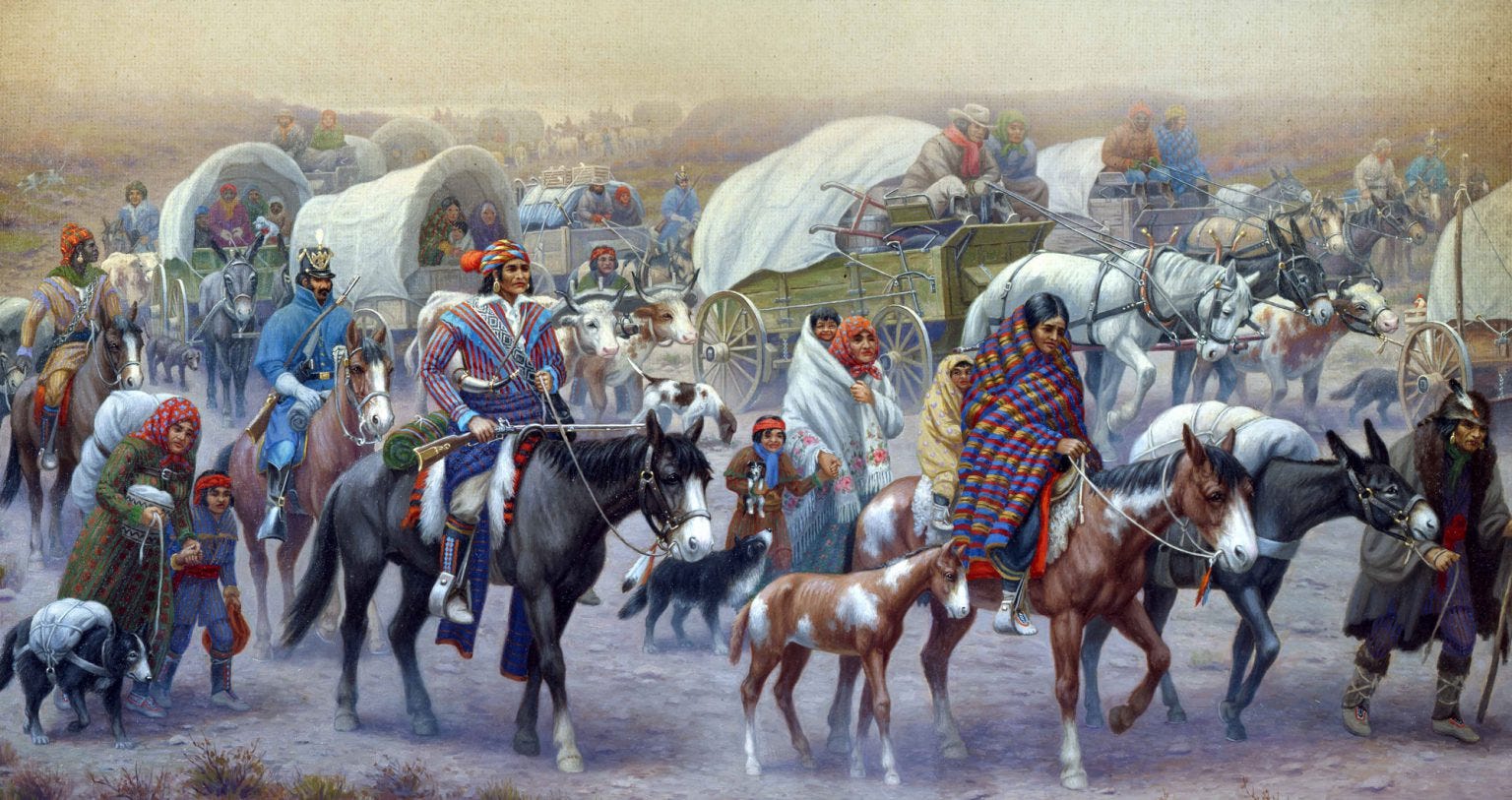
The Trail of Tears by western artist Robert Lindneux
“Settlement” instead of invasion.
Settlers arriving. Farms spreading. Towns establishing. Civilization advancing.
Missing from that vocabulary: Whose land. Who was there. What happened to them.
“Settlement” sounds peaceful. Like finding empty place and building.
Reality: Displacement. Broken treaties. Violence. Forced assimilation. Massacres.
But the word “settlement” hides all that.
“Civilizing mission” instead of domination.
Missionary schools. “Kill the Indian, save the man.” Forced English. Forbidden languages. Stolen children.
Official language: “Assimilation for their benefit. Education. Uplift. Preparing them for modern world.”
Reality: Cultural genocide. Trauma. Generations damaged.
But the phrase “civilizing mission” made it sound like gift, not violence.
The mechanism:
Rename → reduce guilt → reduce resistance → enable continuation
This is Narrative Hygiene:
Linguistic engineering that makes violence disappear inside respectable vocabulary.
You can’t oppose “settlement.” You can oppose invasion.
You can’t question “civilizing mission.” You can question cultural destruction.
The words shape what’s thinkable.
The modern version:
The vocabulary of intervention:
Not: “We bombed civilians.”
But: “Collateral damage occurred during precision strikes.”
Not: “We overthrew government and installed preferred regime.”
But: “Regime change and democratic transition support.”
Not: “We’re controlling resources.”
But: “Stabilization and development assistance.”
“Collateral damage” instead of dead children.
Drone strike hits wedding party. School destroyed. Hospital bombed.
Official statement: “Regrettable collateral damage. Unintended casualties. Unfortunate incident.”
Reality: Bodies. Families destroyed. Communities terrorized.
But the phrase “collateral damage” creates distance.
Makes it sound: accidental, statistical, unfortunate side-effect of necessary operation.
Not: We killed children. But: Damage occurred.
“Development” instead of extraction.
Mining companies enter. Rivers polluted. Mountains removed. Communities displaced.
Corporate language: “Resource development. Economic opportunity. Infrastructure investment. Job creation.”
Reality: Profits extracted. Pollution remains. Jobs temporary. Communities destroyed. Land unusable.
But the word “development” sounds positive. Like building, not destroying.
“Stabilization” instead of control.
Military presence. Bases established. Governments influenced. Resources accessed.
Official framing: “Regional stability. Security cooperation. Partnership.”
Reality: Strategic positioning. Resource access. Geopolitical leverage.
But “stabilization” sounds: helpful, necessary, temporary.
Not: permanent control. But: assistance until stable.
Language doesn’t just describe reality. It creates permission.
SYMBOLS AS INFRASTRUCTURE
The historical version:
School textbooks, 1890s-1950s.
The story taught:
Brave pioneers. Wagon trains facing hardship. Building civilization in wilderness. American spirit of determination.
Images: Families in covered wagons. Men plowing fields. Women in bonnets. Children in one-room schoolhouses.
Missing: Indigenous nations. Broken treaties. Violence. Theft. Ecological destruction.
The narrative effect:
Generations learning: expansion was heroic. Pioneers were brave. America grew through courage and hard work.
Not taught: America grew through conquest backed by military force and legal frameworks designed to seize land.
The textbook story became American mythology.
By time students adult: the story feels natural. Destiny feels real. Expansion feels inevitable.
Symbols trained imagination.
Churches blessing expansion.
Missionaries accompanying settlers. Prayers for successful harvest on “new” land. Thanksgiving celebrations thanking God for bounty.
The religious framing:
God wanted this. Providence guided it. Divine blessing on American project.
Result: Expansion became sacred duty, not political choice.
Can’t oppose what God ordains.
Statues and memorials.
Pioneer monuments in town squares. Homesteader statues. “Settling the West” commemorations.
Each statue saying: This was heroic. This built our nation. This deserves honor.
Not saying: This dispossessed nations. This destroyed ecosystems. This created fortunes through violence.
The stone made the story permanent.
The mechanism:
Symbols train imagination → shape what feels natural → reduce questioning → system runs automatically
Once the story is in textbooks, churches, monuments—it doesn’t need defending. It feels like truth.
The modern version:
Corporate hero narratives.
The story:
Tech founders “changing the world.” Visionaries “disrupting” outdated systems. Innovators “solving problems.”
The imagery: Hoodies and sneakers. Garage startups. “Move fast and break things.” “Think different.”
The message: These people making world better through genius and determination.
Missing from narrative:
Labor exploitation (gig workers, warehouse conditions, content moderators)
Tax avoidance (offshore structures, lobbying for loopholes)
Market consolidation (monopolies crushing competition)
Ecological costs (data center energy, e-waste, mining for minerals)
But the hero story persists.
Musk, Bezos, Zuckerberg framed as pioneers. Not: extractive capitalists. But: visionaries building future.
Same mechanism as pioneer mythology: symbols make extraction feel like progress.
Nation-branding.
“Freedom.” “Democracy.” “Progress.” “Innovation.” “Opportunity.”
These words on:
Currency. Government buildings. Political speeches. Diplomatic statements. Marketing campaigns.
The repetition creates:
Feeling of inevitability. American system = freedom system. American expansion = spreading freedom.
Therefore: Interventions become “promoting democracy.” Military presence becomes “defending freedom.”
The symbols do the work. The words justify themselves.
Tech utopian imagery.
Slick product launches. Videos of better future. Apps “connecting the world.” AI “solving humanity’s problems.”
The message: Technology = progress. More technology = more progress. Resistance = backwards.
Missing: Who benefits. Who pays. What gets destroyed. What consolidates.
But the imagery is compelling.
Sleek design. Inspiring music. Diverse faces smiling. World getting better.
The symbol trains you to accept the system.
Once the symbol is in your head, the system runs itself.
ACCELERATION WITHOUT FUEL: THE COST ARRIVES LATE
The mechanism:
Systems grow faster than the ecological, social, or moral foundations required to sustain them—borrowing against the future to keep moving.
Short-term gains feel like success. Long-term costs accumulate unseen. Then the bill arrives.
The historical version:
Great Plains soil exhaustion, 1930s.
What happened:
Decades of intensive farming. Grasslands plowed. Monoculture wheat. Topsoil depleted.
Then: Drought hits. Nothing holding soil. Wind picks it up.
Dust Bowl. Black blizzards. Farms abandoned. Mass migration to California.
The system worked—for a while.
Wheat production soared 1870s-1920s. Fortunes made. Towns built. Railways profitable.
Then the bill arrived.
Soil gone. Land ruined. Communities destroyed. Government bailouts required.
The acceleration ran ahead of sustainability. Reality caught up.
Broken treaties, cycles of violence.
Each treaty broken → creates resentment → produces resistance → justifies military response → requires new treaty → eventually broken
The pattern:
1851 Fort Laramie Treaty → broken → violence → 1868 treaty → broken → Wounded Knee 1890
The system generated its own crises—then used crises to justify expansion.
Acceleration without addressing root cause: theft of land.
Cost: ongoing violence, trauma, resistance, instability.
But that cost considered “external” to expansion project.
The mechanism:
System optimizes for short-term gains → externalizes long-term costs → costs accumulate unseen → system eventually billed
This is Acceleration Without Fuel:
Running faster and faster on borrowed capacity—ecological, social, political—until capacity exhausted.
Then: collapse, crisis, or bailout.
The modern version:
Ecological collapse.
What’s happening:
Rainforests cleared for soybeans → carbon released → climate disrupted → droughts/floods increase → agricultural system destabilized → food insecurity → migration → political instability
The system worked—for a while.
Soy production soared. Profits increased. GDP grew.
Now the bill arrives:
Climate chaos. Crop failures. Mass migration. Political radicalization. System fragility.
The acceleration ran ahead of planetary boundaries. Reality is catching up.
Migration crises.
Afghanistan, Iraq, Syria, Libya destabilized through intervention → millions displaced → refugee flows to Europe → political backlash → rise of far-right movements → border crises
The interventions were framed as “stabilization.”
Result: Massive destabilization. Refugees fleeing chaos. Nations unable to absorb numbers. Political systems strained.
The cost of intervention: delayed but compounding.
Now appearing as: border politics, xenophobia, democratic backsliding, security crises.
Political radicalization.
Decades of: wage stagnation, wealth concentration, community dissolution, ecological anxiety, political dysfunction
People feel: System not working. Promises broken. Future uncertain.
Result: Rise of extremism. Left and right. Democratic norms eroding. Institutional trust collapsing.
The acceleration of extraction running ahead of social cohesion.
Now the bill arrives: ungovernable societies.
The 19th century got billed in 1930s. The 20th century getting billed now.
WHY THIS STILL MATTERS
We’re not just talking about history.
We’re talking about the operating system of modern power.
Manifest Destiny wasn’t moment in time. It was template.
The template:
Create fear narrative (danger requires expansion)
Optimize extraction (land becomes tool for maximum yield)
Bureaucratize dispossession (paperwork makes it legal)
Sanitize language (violence becomes “development”)
Embed symbols (textbooks/monuments make it feel natural)
Accelerate past sustainability (externalize costs until crisis)
That template didn’t retire in 1890.
It runs today. Different vocabulary. Same mechanisms.
From:
“Manifest Destiny” → “American leadership”
“Civilizing mission” → “Democracy promotion”
“Indian Territory” → “Development zones”
“Settlement” → “Investment”
“Taming wilderness” → “Unlocking potential”
The story changed. The operating system didn’t.
If we don’t see the story, we can’t question it.
When expansion is “destiny”—you can’t oppose destiny.
When intervention is “stabilization”—you can’t oppose stability.
When extraction is “development”—you can’t oppose development.
The language hides the choice.
Makes it appear: inevitable, natural, beyond politics.
But it’s not destiny. It’s decision.
Decision to value extraction over sustainability. Control over reciprocity. Profit over people. Acceleration over enough.
Those decisions made by humans. Can be unmade by humans.
The first step: seeing the mechanism.
Once you see Fear Loop—you see it everywhere.
Once you see Optimization Trap—you recognize it operating.
Once you see Bureaucratic Blindness—you spot the paperwork hiding reality.
Once you see Narrative Hygiene—you hear the sanitized language.
Once you see Symbols as Infrastructure—you see mythology training imagination.
Once you see Acceleration Without Fuel—you see bills coming due.
The mechanisms are portable. They repeat.
Different contexts. Different justifications. Same operating system.
Manifest Destiny was template. We’re still running it.
WHAT A DIFFERENT STORY WOULD LOOK LIKE
Brief reflection—not prescription.
Instead of:
Extraction → Stewardship
Endless expansion → Enough
Optimization for single metric → Resilience through diversity
Bureaucratic invisibility → Recognition of lived reality
Destiny → Choice
What would it mean:
To ask “should we?” before “how do we maximize?”
To see land as ecosystem, not resource waiting for optimization
To recognize communities exist even without paperwork
To call violence “violence” instead of “collateral damage”
To teach actual history instead of heroic mythology
To accept limits instead of accelerating past them
Not utopian prescription.
Just: different operating system. Different questions. Different values embedded in decisions.
The current system isn’t inevitable.
It was built. By choices. Justified by stories. Maintained through mechanisms.
Different choices possible. Different stories available. Different mechanisms could run.
The grasslands knew how to be grasslands for millennia.
The buffalo. The nations who followed them. The ecosystem that sustained them.
Then optimization arrived.
Asked: “How many cattle can this support?” Didn’t ask: “Should we replace this functioning system?”
The optimization succeeded. The ecosystem collapsed.
Now we’re optimizing planet.
Asking: “How much can we extract? How fast can we grow?”
Not asking: “Should we? What are we destroying? What happens when capacity exhausted?”
The 19th century gives us the preview.
Soil exhaustion. Species extinction. Social collapse. Violence. Migration. Crisis.
Then: localized. Now: global.
Same template. Bigger scale. No frontier to run to when this one exhausted.
The story matters.
Because the story trains imagination. And imagination determines what feels possible.
Manifest Destiny made expansion feel inevitable.
What story would make enough feel natural?
What mythology would make stewardship feel like destiny?
That’s the work.
Not just opposing current system. But building different story. Different symbols. Different imagination.
Because the mechanisms run on stories.
Change the story—change what feels possible.
The old destiny is still running. But destiny was always fiction.
Time to write different one.
MECHANISM TAKEAWAY
Fear Loop: Create danger → justify expansion as protection → expansion creates new dangers → repeat.
Optimization Trap: Maximize single metric → externalize all costs → celebrate output → collapse arrives later.
Bureaucratic Blindness: If not documented, doesn’t exist → paperwork justifies dispossession.
Narrative Hygiene: Rename violence → reduce guilt → reduce resistance → enable continuation.
Symbols as Infrastructure: Control textbooks/monuments/media → shape imagination → system self-perpetuates.
Acceleration Without Fuel: Optimize past sustainable limits → externalize costs → bills compound → crisis arrives.
Manifest Destiny wasn’t moment—it was template. Same mechanisms run today with different vocabulary.
If this changed how you see “development,” “progress,” “inevitable” expansion—share it. We understand power better when we see the operating system, not just the stories it tells.
This is part of an ongoing series examining how systems justify themselves—and what happens when we stop believing the justifications.
Subscribe for weekly essays on how power wraps itself in destiny—and why destiny was always a choice, not a fact.
After what happened in Venezuela today, this felt especially relevant to revisit. Different country, different vocabulary — but the same old story of “inevitable” power showing up again.