

BROKEN ARROWS
How the World Learned to Live with Almost-Disaster

I.
Goldsboro, North Carolina. January 24, 1961. 12:30 AM.
A B-52 Stratofortress breaks apart at 10,000 feet.
The right wing has been leaking fuel for hours. The crew tried everything. Nothing worked. The leak became a flood. Major Tulloch ordered the bailout.
Five men ejected successfully.
Three did not survive.
Two Mark 39 hydrogen bombs fell toward farmland.
Each bomb: 3.8 megatons. Two hundred sixty times the yield of Hiroshima.
One bomb deployed its parachute. Descended slowly. Landed intact in a tree.
The other plummeted.
Struck the ground at several hundred miles per hour.
Drove itself fifty feet into soft Carolina mud.
Later, investigators would extract what remained. They would examine the arming mechanisms. They would discover that three of the four safety switches had failed during the fall.
Three out of four.
One switch remained. A single low-voltage switch. The size of a coin.
That switch prevented the bomb from completing its arming sequence.
A farmer named Wendell Brown found the parachute in his field. Wreckage scattered across his land. A piece of metal sticking up from the earth.
The military secured the area. Recovered what they could.
The official report called it “contained.”
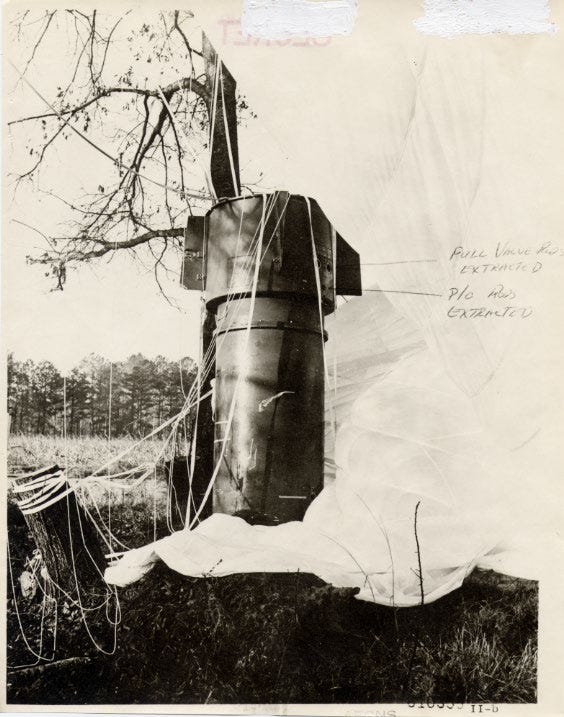
Weapon No. 1, a Mark 39 Mod 2 thermonuclear weapon, as found by the explosive ordnance disposal team after the 1961 Goldsboro B-52 crash.
This isn’t a story about explosions.
This is a story about how systems drift toward catastrophe — and learn to call that “normal.”
II.
We were told a story.
The story went like this:
Nuclear weapons exist under perfect control. Highly trained crews. Impossible redundancies. Impeccable procedures. Fail-safes within fail-safes. Command protocols refined across decades.
The story said: We have mastered the atom.
The story was necessary.
But the story wasn’t true.
What existed wasn’t mastery.
It was management.
Probability.
Acceptable risk.
The bombs still flew. The missions continued. The strategic advantage required it.
This is Victory High — the myth that achievement equals control.
When a civilization achieves something unprecedented — splitting atoms, reaching orbit, connecting billions of devices — the achievement produces its own mythology.
The mythology says: If we did this impossible thing, we can control it perfectly.
The mythology becomes doctrine. Doctrine becomes policy.
Policy becomes the lens through which all information gets filtered.
Evidence that contradicts the mythology gets reclassified, buried, or explained away.
This is how big systems function. They need the illusion of control. Without it, they cannot maintain legitimacy.
And without legitimacy, they cannot maintain the resources required to continue operating.
So the illusion must be protected.
Even when the wreckage is sticking out of the mud.
III.
The military has a term for these events.
Broken Arrow.
The designation covers any serious accident involving nuclear weapons: loss, damage, crash, accidental drop, fire, contamination.
The definition excludes one thing: actual nuclear detonation.
That’s a different category. That’s called something else.
The terminology exists to make disaster sound administrative.
Broken Arrows are the near-misses. The almosts. The times when luck did the work.
Between 1950 and 1980, the U.S. military officially acknowledged thirty-two Broken Arrows.
Unofficial estimates run higher.
The important part isn’t the accidents themselves.
The important part is what the accidents reveal about how systems handle near-catastrophe.
What they reveal: Luck gets mistaken for competence. Survival gets recorded as policy. Chance masquerades as control.
And then systems continue.
IV.
Goldsboro: The Coin-Flip Bomb
Return to that field in North Carolina.
That final switch.
The Air Force investigated. They classified most findings. They publicly minimized the danger.
Secretary of Defense Robert McNamara later wrote: “By the slightest margin of chance, literally the failure of two wires to cross, a nuclear explosion was averted.”
But publicly, the message stayed consistent: The system worked. The safety mechanisms performed as designed. No danger to the public existed.
This interpretation requires ignoring three facts:
First: Three safety mechanisms failed.
Second: The bomb armed itself during the fall. It was executing its detonation sequence. Only one component prevented completion.
Third: That component — a low-voltage switch — was never designed to be the last line of defense. It was backup for the backups.
The system failed — and a coin-sized switch saved it.
That isn’t safety.
That’s luck wearing a uniform.
But because nothing exploded, the conclusion became: The system worked.
This is the Optimization Trap meeting Bureaucratic Blindness.
The Optimization Trap says: Maximize mission capability. More flights. Longer flights. Fuel loads pushed to limits. Maintenance schedules compressed. Training standardized.
Bureaucratic Blindness says: If the paperwork says “resolved,” the danger disappears.
The result: Systems learn to treat near-catastrophe as validation rather than warning.
Palomares: The Village That Got Dusted
Spain. 1966.
A B-52 collided with its refueling tanker during a routine operation over the Mediterranean.
Four hydrogen bombs fell.
Two landed in or near the village of Palomares.
Both bombs experienced conventional explosive detonation on impact. High explosives surrounding the nuclear cores detonated as designed. The nuclear materials did not achieve critical mass. No mushroom cloud.
Instead: plutonium dust spread across farmland.
Farmers watched from behind fences as men in protective suits walked through their tomato fields.
The U.S. military arrived quickly. Secured the area. Began cleanup. Located three bombs within days.
The fourth bomb remained missing.
It had fallen into the Mediterranean. Search operations continued for months. Submarines, sonar, underwater cameras. Finally located. Retrieved.
Meanwhile, back in Palomares:
The contamination required removing topsoil from multiple sites. Workers loaded contaminated earth into barrels. Coughing through masks. Shipping it to the United States. Years of decontamination work.
The Spanish government wanted reassurance.
The U.S. government provided theater.
The Minister of Information went swimming. Public photos at local beaches. American ambassador joined him.
Smiling.
Waving.
Performing safety.
Behind the scenes: Ongoing sampling. Persistent contamination. Restrictions on local agriculture that lasted decades.
This is the Fear Loop meeting Narrative Management.
The Fear Loop says: Panic must be prevented at all costs. Public confidence must be maintained. Ally relationships preserved.
Narrative Management says: Control the story through imagery. Minimize through euphemism. Classify the uncomfortable details.
The result: Secrecy plus public relations replaces actual reform.
The dangerous truth gets buried under reassuring photographs.
Thule: Fire on the Ice
Greenland. 1968.
A B-52 crashed seven miles from Thule Air Base. The crash sparked an intense fire.
Four nuclear bombs aboard. All four experienced conventional explosive detonation in the fire.
Plutonium scattered across Arctic ice.
The cleanup operation became Project Crested Ice. Danish and American personnel worked through Arctic winter. Minus-thirty winds. Contaminated ice that burned exposed skin. Collected fragments. Loaded it into barrels. Shipped it back to the United States.
559,000 pounds of contaminated material.
Later investigations revealed: One weapon component remained unaccounted for.
Gone. Still out there.
Missing pieces don’t erase risk. They erase accountability.
But here’s the detail that reveals how systems actually function:
These flights — nuclear weapons flying over Greenland — violated explicit policy.
After the Palomares incident, the military established strict restrictions on airborne nuclear weapons. Reduce unnecessary risk. Ground operations where possible.
But maintaining “readiness” required continuous airborne presence.
So the policy was quietly adjusted.
Chrome Dome missions continued. Bombs kept flying.
Right up until one crashed into the ice.
This is the Optimization Trap again, now combined with Victory High.
Optimization Trap: Readiness over redundancy. Speed over safety. Mission capability over caution.
Victory High: We are so advanced, so professional, so technically superior that we can manage risks that would be unacceptable for anyone else.
The result: Policy bends to operational convenience. Appearances matter more than actual safety. And when something goes wrong, the response focuses on cleanup rather than system redesign.
V.
Why do systems forget their near-death experiences?
The Three-Part Amnesia
Bureaucratic Blindness says: Once an incident is documented, investigated, and filed, it stops being dangerous. The paperwork resolves the threat.
Optimization Trap says: Safety margins cost money and reduce capability. Every redundancy is inefficiency. Every precaution is overhead.
Fear Loop says: Acknowledging danger risks multiple catastrophes — public panic, political fallout, appearing weak, losing funding, admitting vulnerability.
The Confidence Spiral
These three mechanisms create a specific outcome:
Near-misses don’t trigger reform. They trigger confidence.
Leaders point to the fact that nothing exploded. They celebrate the safety mechanisms that worked. They emphasize professional crew behavior. They highlight the successful cleanup.
The fact that the system failed at every level except one becomes invisible.
The fact that luck made the difference becomes unmentionable.
The Invisible Infrastructure
It’s always there. Humming in the background. Unexamined. Assumed to be handled.
Until it isn’t.
The result: Risk becomes invisible infrastructure.
VI.
When “Almost” Becomes “Never”
The danger of “almost” is this:
When nothing explodes, the natural conclusion becomes: “See? The system worked.”
But that conclusion requires forgetting several things:
Near-misses don’t represent system success. They represent system failure combined with fortune.
The fact that catastrophe didn’t occur doesn’t mean catastrophe wasn’t probable. It means catastrophe wasn’t certain.
There’s a difference.
The Overconfidence Loop
Systems that survive near-misses through luck rarely recognize luck as a factor. They attribute survival to their own excellence.
This attribution produces overconfidence.
Overconfidence produces further risk-taking.
Further risk-taking produces more near-misses.
The cycle continues until luck runs out.
And systems never schedule the day luck fails.
How Civilizations Actually Collapse
Civilizations don’t collapse when one thing fails.
They collapse when systems train themselves not to notice failure.
They collapse when near-catastrophe becomes redefined as acceptable performance.
They collapse when the people running the systems look at the wreckage in the mud and conclude: Everything worked as designed.
VII.
The Broken Arrow pattern doesn’t stop with nuclear weapons.
It repeats everywhere systems operate near critical thresholds while maintaining the mythology of perfect control.
The Algorithm That Learned to Ignore Warnings
Consider content recommendation systems.
2016: Internal researchers at a major platform discover their algorithm amplifies divisive content.
Posts that make people angry get more engagement. More engagement means better metrics. Better metrics mean the system is working.
The researchers document this. They show how recommendation pathways create radicalization funnels. They demonstrate measurable harm. They file reports.
Management reviews the findings. They note: User engagement is increasing. Revenue is up. The system is performing within acceptable parameters.
No fundamental changes implemented.
2018: Journalists document how the same algorithm helped fuel ethnic violence in Myanmar. Recommendation systems amplified hate speech. Content moderation failed at scale. People died.
The company expresses concern. They hire more moderators. They adjust some parameters. They release a statement about their commitment to safety.
The core algorithm continues optimizing for engagement.
2020: A whistleblower releases internal documents. They show the company knew about the harms.
They had the data.
They had the warnings.
They had internal reports.
They chose growth.
The pattern holds:
Near-miss → internal report → parameter adjustment → continue.
The difference from nuclear Broken Arrows: This one happens millions of times per day. The harm distributes across populations instead of concentrating in a single moment. The catastrophe unfolds in slow motion.
But the mechanism stays identical.
Probability masquerading as control. Luck mistaken for competence. Optimization pressed past human tolerances.
The Pattern Everywhere Else
Healthcare databases leak millions of patient records. “Contained incident.” Software patch deployed. PR statement released. Same vulnerable systems continue operating. No fundamental redesign.
Engineers report cracks in bridges. Multiple warnings filed. Inspections performed. Bridges “pass inspection” because the inspection criteria haven’t kept pace with aging infrastructure. Then a bridge collapses. Everyone expresses shock. The paperwork said it was safe.
Record temperatures become “the new normal.” Scientists issue warnings. Reports get filed. Conferences convened. Action deferred. Each year sets a new record. Each record gets absorbed into baseline. The system adapts to emergency by redefining emergency as ordinary.
The pattern stays consistent:
Near-miss → euphemism → documentation → forget.
The system survives. The system declares victory. The danger remains.
VIII.
What would a sane system do?
This isn’t idealism.
Treat near-misses as disasters that almost happened. Not as validation. Not as proof that safety mechanisms work. As warnings that luck was required.
Reward people who report danger. Not punish them. Not silence them. Not reclassify their concerns. Create incentives for honesty rather than reassurance.
Separate truth-finding from reputation-protection. Investigations that serve organizational legitimacy produce conclusions that serve organizational legitimacy. Truth-finding requires independence from consequence.
Build slack back into systems. Redundancy isn’t waste. Redundancy is the difference between graceful degradation and catastrophic failure. Margin isn’t inefficiency. Margin is what makes survival possible when something unexpected happens.
This connects to the larger framework:
Resilience isn’t efficiency.
Resilience is the capacity to be wrong without dying.
Resilience is what remains when optimization finally fails.
Efficient systems are brittle. They operate at thresholds. They eliminate margin. They convert slack into capability. They run hot.
And when they fail, they fail completely.
Resilient systems waste resources. They maintain redundancy. They preserve slack. They operate below theoretical maximum.
And when they fail, they fail gradually. With warning. With time to respond.
The choice between these approaches is really a choice about what kind of failure you can survive.
IX.
Return to Goldsboro.
That field in North Carolina.
That last switch.
That thin piece of metal no bigger than a coin.
For a few minutes in 1961, the fate of millions of people rested on a component that could be purchased in a hardware store.
The bomb was armed. The sequence was executing. The detonation was imminent.
One switch prevented completion.
Not sophisticated design. Not advanced safety systems. Not highly trained personnel making split-second decisions.
A switch.
It held. The bomb didn’t explode. Life continued.
And the system interpreted this outcome as evidence of its own excellence.
The story declared victory. The system learned nothing.
How many systems today are running on switches like that?
How many systems operate daily at thresholds where single-point failures would cascade into catastrophe?
How many systems have convinced themselves they’re safe because the catastrophe hasn’t happened yet?
The Broken Arrows teach one lesson clearly:
Systems don’t collapse when they fail once.
They collapse when they successfully absorb so many near-failures that they forget what failure looks like.
They collapse when “almost” becomes indistinguishable from “never.”
They collapse when the wreckage in the mud gets classified as proof that everything worked.
The bombs are still flying.
They just have better stories wrapped around them.
They always have been.
The question isn’t whether systems can achieve perfect safety.
The question is whether systems can remember what near-death feels like.
And whether they can learn from it before luck runs out.
What struck you most here — the history, or the modern parallels?
I’m curious: where else do you see “luck pretending to be safety” in systems we rely on every day?